By Gulf news, Joseph A. Kechichian, Senior Writer
Beirut: Nabih Berri, the Speaker of the Lebanese Parliament and the highest-ranking Shiite leader, accused Free Patriotic Movement (FPM) founder General Michel Aoun and Future Movement leader and former prime minister Saad Hariri of seeking to “topple political Shiism” in Lebanon.
His strong warning — that such an attempt might lead to a new “civil war” in the country — prompted Hezbollah chief Hassan Nasrallah to distance himself and his party from ally Aoun in what was little short of a political tsunami.
The pro-Hezbollah Al Akhbar daily quoted aides to Berri lamenting Hariri’s choice, which apparently “triumphed [as] he revived the 1943 pact with Aoun”. “We will be outside of power — among the ranks of the opposition,” it said, continuing: “What they [Aoun and Hariri] are doing will lead to a civil war and we will fight to defend ourselves and Hezbollah!”
by khaleejtimes.com – Dubai offers Lebanese tech start-ups the opportunity to gain global exposure and investment at one of the world’s most …

By Huffington Post-
Do Middle East/North Africa (MENA) consumers and producers of media in all their permutations and across countless platforms fully comprehend what they’re doing and how they fit in the larger scheme of things?
Do various groups and individuals take the time to deconstruct messages, processes, outcomes and repercussions of all the interactivity, integration, convergence and overwhelming flow of communications that keeps morphing into new shapes at speeds we can hardly keep up with?
It’s as dizzying as Mork from the planet Ork, American comedian Robin Williams’ famous TV character, credited in part with paving the way to our truncated media consumption habits from back in the 1970s.
“Robin Williams Was An Unwitting Prophet of the Internet Era,” headlined Business Insider to a story about Williams’ frenetic and breathtaking influence on us.
According to writer Aaron Gell, Williams channeled culture; his cut-and-paste style echoed what rappers were doing with samples, and like them, he occasionally got into trouble for borrowing material.

.- Christianity is at a crossroads in the Middle East, and only a dedicated campaign of aid and activism can help Christians survive as a merciful, forgiving leaven in the region, said the head of the Knights of Columbus Wednesday.
“Either Christianity will survive and offer a witness of forgiveness, charity and mercy, or it will disappear, impoverishing the region religiously, ethnically and culturally,” Carl Anderson, Supreme Knight and CEO of the Knights of Columbus, said Oct. 12.
His remarks came at the awards banquet for the Path to Peace Award. Archbishop Bernardito Auza, the apostolic nuncio heading the Holy See’s permanent observer mission to the U.N., conferred the award in recognition of the Knights of Columbus’ work in the Middle East and their humanitarian work throughout the world. The award is granted by the Path to Peace Foundation, which supports the Holy See’s U.N. mission.
Anderson outlined three steps to aid the Christians of the Middle East. “The first step on the path to peace in this region has been taken,” he said. “Christians have forgiven their persecutors. The second step must be a level of government funding directed to those communities that have faced genocide, so that they, and their witness, can survive. The third step must be the creation of real equality regardless of religious belief.”
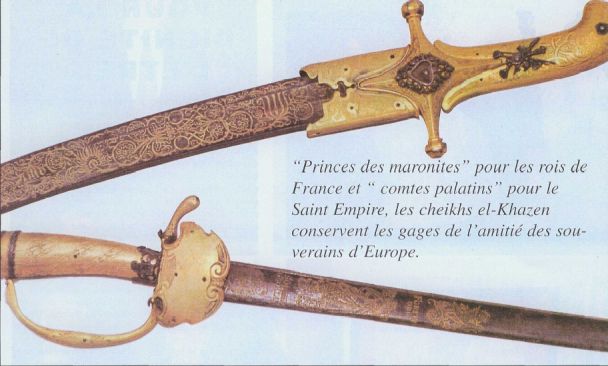
Population Movements to Keserwan - The Khazens and The Maans
ما جاء عن الثورة في المقاطعة الكسروانية
ثورة أهالي كسروان على المشايخ الخوازنة وأسبابها
Origins of the "Prince of Maronite" Title
Growing diversity: the Khazin sheiks and the clergy in the first decades of the 18th century
Historical Members:
Barbar Beik El Khazen [English]
Patriach Toubia Kaiss El Khazen(Biography & Life Part1 Part2) (Arabic)
Patriach Youssef Dargham El Khazen (Cont'd)
Cheikh Bishara Jafal El Khazen
Patriarch Youssef Raji El Khazen
The Martyrs Cheikh Philippe & Cheikh Farid El Khazen
Cheikh Nawfal El Khazen (Consul De France)
Cheikh Hossun El Khazen (Consul De France)
Cheikh Abou-Nawfal El Khazen (Consul De France)
Cheikh Francis Abee Nader & his son Yousef
Cheikh Abou-Kanso El Khazen (Consul De France)
Cheikh Abou Nader El Khazen
Cheikh Chafic El Khazen
Cheikh Keserwan El Khazen
Cheikh Serhal El Khazen [English]
Cheikh Rafiq El Khazen [English]
Cheikh Hanna El Khazen
Cheikha Arzi El Khazen
Marie El Khazen