By Jeremy Weber is CT senior news editor.
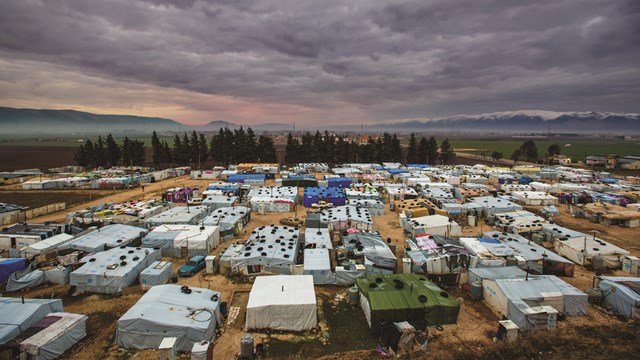
Faysal stands amid the rolling fields of the Bekaa Valley. Just down the road are award-winning, decadent vineyards—a product of the fertile agricultural region’s 5,000-year head start on Napa Valley. The Romans even chose to build their temple to Bacchus here. Above loom the snow-covered slopes of Mt. Hermon, where many today place Jesus’ transfiguration. Surveying the sea of green plants rustling in a pleasant breeze, the 43-year-old describes what he feels: “A knife in my heart.”
For Faysal, a Syrian refugee, the scene is not one of grandeur but of guilt; in the field before him are three of his children—his 15-year-old son and 13- and 11-year-old daughters—bent in half as they weed potatoes instead of attending school.
“I have no choice,” says the father of six. In Aleppo, one of Syria’s most war-torn cities, his job as a truck driver once provided a four-room house and a middle-class, urban life. Now, having injured his back in his own efforts at day labor, he can’t pay the rent for their cobbled-together shelter on a farmer’s property. So he just stands and watches his children. And cries.

by Belen Fernandez
On 30 August, the International Day of the Disappeared will once again be observed. In Lebanon, where an estimated 17,000 persons are still missing on account of the “civil” war that ravaged the country - with plenty of outside help - from 1975 until 1990, it will mark yet another year of unanswered questions for family members of the victims.
Earlier this year, I spoke with one such family member: a silver-haired man named Abed, whose younger brother, Ahmad, joined the PLO in 1983 at the age of 17 and then promptly disappeared. Over pineapple juice in the garden of his home in the tiny south Lebanese village of Maaroub, Abed recounted the decades of futile searches for Ahmad.
During one period, the family was strung along by an enterprising fellow involved in a missing persons scam industry; in exchange for several hefty payments, he produced what he claimed was an official paper from a prison in Aleppo, Syria, confirming that Ahmad was being held there.

There are delicate-sounding Arab pop-stars – and then you have Assi El Helani. Nicknamed "The Knight of the Arab Song", the Lebanese singer is a powerful presence – both on stage and television screens as a mentor on MBC’s reality-singing contest, The Voice. Speaking of voice, his is a full-bodied husky tenor that captures the drama and heartache of the original and classic Levantine folk songs that have become his calling card.
When we caught up with the 45-year-old at this summer’s Mawazine Festival in Rabat, Morocco, El Helani said he is proud that he has helped to revive the once-neglected Arab folk music genre. More so than talent, however, he credits his success to hard work – something he repeatedly reiterates to the youngsters he guides on The Voice.
![[file photo]](https://i0.wp.com/www.middleeastmonitor.com/wp-content/uploads/2016/08/female-israeli-soldiers.jpg?resize=1200%2C800&ssl=1)
by middleeastmonitor.com
Lebanon’s foreign minister has asked his country’s diplomats at the UN to file a complaint “urgently” to the Security Council regarding the latest Israeli violations of Lebanese sovereignty, Anadolu reported on Friday. Israel continues to occupy the southern Lebanese towns of Al-Ghajar and Shabaa Farms.
Jobran Bassil has sent a letter referring to Israel’s violation of UN Security Council Resolution 1701 regarding the rights of the Lebanese people and Lebanon’s sovereignty. “Since the Israeli occupation forces persist in violating Lebanon’s sovereignty and fail to comply with international resolutions, particularly 1701, we hereby ask you [the diplomats] to inform the concerned authorities in the United Nations, particularly the Security Council, of Israel’s offences in the occupied Lebanese part of Al-Ghajar and Shebaa Farms.”
According to the Chinese Xinhua news agency, Israel has imposed new rules, regulations and taxes in the occupied parts of Al-Ghajar as well new illegal settlements. In addition, the construction of new roads and other infrastructure has started in the occupied Shebaa Farms area.


Population Movements to Keserwan - The Khazens and The Maans
ما جاء عن الثورة في المقاطعة الكسروانية
ثورة أهالي كسروان على المشايخ الخوازنة وأسبابها
Origins of the "Prince of Maronite" Title
Growing diversity: the Khazin sheiks and the clergy in the first decades of the 18th century
Historical Members:
Barbar Beik El Khazen [English]
Patriach Toubia Kaiss El Khazen(Biography & Life Part1 Part2) (Arabic)
Patriach Youssef Dargham El Khazen (Cont'd)
Cheikh Bishara Jafal El Khazen
Patriarch Youssef Raji El Khazen
The Martyrs Cheikh Philippe & Cheikh Farid El Khazen
Cheikh Nawfal El Khazen (Consul De France)
Cheikh Hossun El Khazen (Consul De France)
Cheikh Abou-Nawfal El Khazen (Consul De France)
Cheikh Francis Abee Nader & his son Yousef
Cheikh Abou-Kanso El Khazen (Consul De France)
Cheikh Abou Nader El Khazen
Cheikh Chafic El Khazen
Cheikh Keserwan El Khazen
Cheikh Serhal El Khazen [English]
Cheikh Rafiq El Khazen [English]
Cheikh Hanna El Khazen
Cheikha Arzi El Khazen
Marie El Khazen