The Daily Star BEIRUT: Lebanon’s Foreign Ministry offered its condolences Friday to Italy over a powerful earthquake two days earlier that caused …

by Josh Wood
Saudi’s oil price fallout echoes beyond the bounds of the GCC. For more on how it is affecting Pakistan - Lebanon’s economy has long depended on the Arab Gulf states.
Hundreds of thousands of Lebanese work there, sending their savings home to relatives. It is the main destination for exports — both human capital and produced goods — as well as the leading supplier of investment. There is often a feeling that without the Gulf’s role, Lebanon’s beleaguered economy could not survive. But this relationship could be in trouble.
With global oil prices falling since 2014, the economic diversification plans touted by Gulf states are finally being put to the test. For the many Lebanese working in the Gulf, their livelihoods and billions of dollars in annual remittances, depend on the continued strength of these economies. More immediate is the growing divide between GCC countries and the Lebanese government over the role of Hizbollah, with Saudi Arabia leading the charge against the group and economists fearing major economic ramifications on Lebanon.

SEOUL, South Korea - Lebanese Cardinal Bechara Rai, visiting the South Korean capital of Seoul, said that terrorist organizations “working for the destruction of the Middle East do not represent Islam or Muslims.” Such groups, he said in an address during the Forum for Peace on the Korean Peninsula that met Aug. 18-21, work to destroy “a moderate and open Islam, resulting from coexistence with Christians.”
Rai also urged the international community to end the wars raging in the Middle East “fueled by foreign countries.” Rai addressed the forum under an invitation of Seoul Cardinal Andrew Yeom Soo-jung, imploring the international community “to speed up the solutions and impose a halt to the wars, fueled by foreign countries, raging in the Middle East.”
Stressing the need for a “series of reforms” in the Arab states, Rai called for the separation of state and religion, the development of democracy and “respect for human rights and fundamental freedoms.”
He also called on the international community to “help the rapprochement between Iran and Saudi Arabia” which he said would reduce sectarian tension in the region.

By Vivian Haddad - aawsat.com
Beirut-Lebanese cooks were not surprised when Beirut ranked in first place as the Best International Cities for Food, according to statistics released by Travel + Leisure (T+L) website. They all know that this achievement is the result of years of efforts to spread the Lebanese cuisine across the world, which made them excellent ambassadors for the national cuisine.
The mentioned website carries out an annual survey “The World’s Best
Awards” to ask travelers to weigh in on travel experiences around the
globe to share their opinions and tourism experiences.
This year, Beirut’s gastronomy has beaten European and Asian countries;
Lebanese delicious platters have stolen lights from cities like Paris,
Florence, Bordeaux, Saint Miguel, and Rome despite their excellence in
the field.
Readers of the website shared their opinions on the top cities, islands, cruise lines, spas, airlines, and more. Results showed that Beirut has succeeded in capturing the first place among ten other countries for serving best platters in its restaurants. The Lebanese capital was respectively followed by San Sebastian, Paris, Florence, Bologna, Roma, Saint Miguel, Chiang Mai, Barcelona, and Bordeaux.

Population Movements to Keserwan - The Khazens and The Maans
ما جاء عن الثورة في المقاطعة الكسروانية
ثورة أهالي كسروان على المشايخ الخوازنة وأسبابها
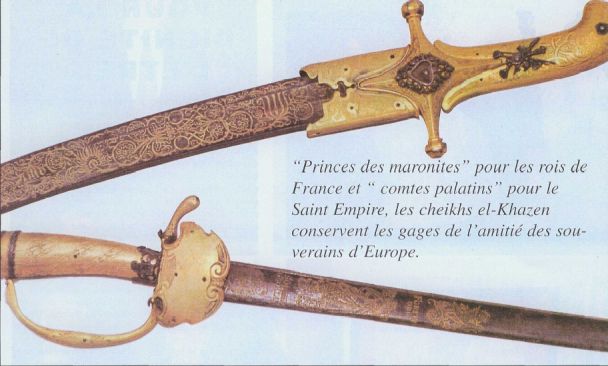
Origins of the "Prince of Maronite" Title
Growing diversity: the Khazin sheiks and the clergy in the first decades of the 18th century
Historical Members:
Barbar Beik El Khazen [English]
Patriach Toubia Kaiss El Khazen(Biography & Life Part1 Part2) (Arabic)
Patriach Youssef Dargham El Khazen (Cont'd)
Cheikh Bishara Jafal El Khazen
Patriarch Youssef Raji El Khazen
The Martyrs Cheikh Philippe & Cheikh Farid El Khazen
Cheikh Nawfal El Khazen (Consul De France)
Cheikh Hossun El Khazen (Consul De France)
Cheikh Abou-Nawfal El Khazen (Consul De France)
Cheikh Francis Abee Nader & his son Yousef
Cheikh Abou-Kanso El Khazen (Consul De France)
Cheikh Abou Nader El Khazen
Cheikh Chafic El Khazen
Cheikh Keserwan El Khazen
Cheikh Serhal El Khazen [English]
Cheikh Rafiq El Khazen [English]
Cheikh Hanna El Khazen
Cheikha Arzi El Khazen
Marie El Khazen