Mia Bloom, The Conversation
This week the world once again witnessed an Islamic State’s use of at least one child bomber, perhaps two. A child between the ages of 12 and 14 was reportedly the culprit behind a suicide attack – blowing up the wedding of Besna and Nurettin Akdogan in Gaziantep, Turkey and killing 54 people on Aug. 20.
Although now the Turkish government is not certain whether it was a child or an adult, it’s certainly not the only time children have been used by terrorist networks to perpetrate attacks. The following day, a child was caught before he could detonate a suicide bomb at a Shi’a school in Kirkuk, Iraq.
During the course of research for our book, “Small Arms: Children and Terror,” John Horgan and I have learned how IS socializes children into their terrorist network. We have also had the opportunity to meet with children who have been rescued from terrorist groups in Pakistan.
by Rafi Letzter There’s an endless supply of fad diets out there. Many of them have at least some studies to back them …

By Pamela Engel- Business Insider
The terrorist group ISIS, while dealing with a consistent loss of territory in Iraq and Syria and unfulfilled plans for Libya, has shed benefits and raised taxes as it starts running out of money. An ISIS memo found earlier this year saying the group had cut salaries for fighters by 50% was widely circulated as evidence of the group's financial problems.
But Adam J. Szubin, the acting under secretary for terrorism and financial intelligence at the US Treasury Department, explained that's not the extent of the measures ISIS has taken to rein in its spending. "Overall, ISIL is significantly constrained in terms of its funding," he told the CTC Sentinel, a publication of the Combatting Terrorism Center at West Point.
Szubin noted that ISIS is cutting benefits as it tries to deal with a cash crunch. "We received information earlier this year indicating that ISIL stopped paying death benefits to families of ISIL personnel," Szubin said. "That's a core benefit that a group like ISIL needs to promise to the families of those going on suicide or likely suicide missions in order to maintain their operational tempo."

BEIRUT // For a city still divided more than 25 years after the end of Lebanon’s civil war, Beirut is embarking on a journey to preserve fading memories of the conflict in the once-residential building-turned snipers’ lair of Beit Beirut or house of Beirut. Also known as the Barakat house, the building – which sits on Damascus Road and straddles the green line that used to separate Christian East Beirut and Muslim West Beirut – will be transformed into a museum and cultural centre when it opens in late September this year.
The ochre Ottoman-style edifice with elements of Art Deco and Rocco styles will tell the stories of the snipers who once lived and fought within its walls, as well as the story of the bourgeois Barakat family, who commissioned the building in 1924. It was designed by Lebanese architect Youssef Afandi Aftimos, with two more stories added by architect Fouad Kozah in 1932. Aftimos was a well-known architect, who built the grand theatre in downtown Beirut and the clock tower of the Grand Serai, now the seat of the Cabinet.
The Barakat family plaque still hangs in the ruins of the building, surrounded by pockmarked walls that serve as a lasting memory of the 15-year civil war that killed more than 100,000 people and left several building carcasses strewn along the green line.
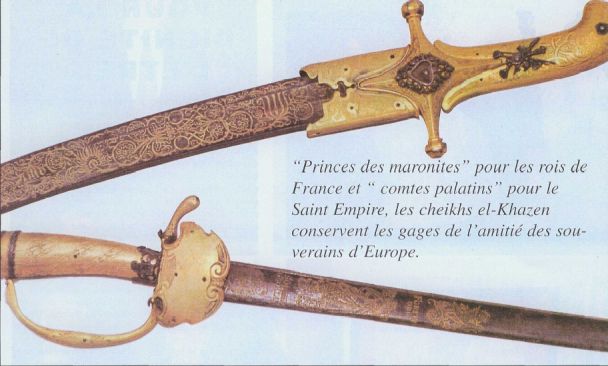

Population Movements to Keserwan - The Khazens and The Maans
ما جاء عن الثورة في المقاطعة الكسروانية
ثورة أهالي كسروان على المشايخ الخوازنة وأسبابها
Origins of the "Prince of Maronite" Title
Growing diversity: the Khazin sheiks and the clergy in the first decades of the 18th century
Historical Members:
Barbar Beik El Khazen [English]
Patriach Toubia Kaiss El Khazen(Biography & Life Part1 Part2) (Arabic)
Patriach Youssef Dargham El Khazen (Cont'd)
Cheikh Bishara Jafal El Khazen
Patriarch Youssef Raji El Khazen
The Martyrs Cheikh Philippe & Cheikh Farid El Khazen
Cheikh Nawfal El Khazen (Consul De France)
Cheikh Hossun El Khazen (Consul De France)
Cheikh Abou-Nawfal El Khazen (Consul De France)
Cheikh Francis Abee Nader & his son Yousef
Cheikh Abou-Kanso El Khazen (Consul De France)
Cheikh Abou Nader El Khazen
Cheikh Chafic El Khazen
Cheikh Keserwan El Khazen
Cheikh Serhal El Khazen [English]
Cheikh Rafiq El Khazen [English]
Cheikh Hanna El Khazen
Cheikha Arzi El Khazen
Marie El Khazen