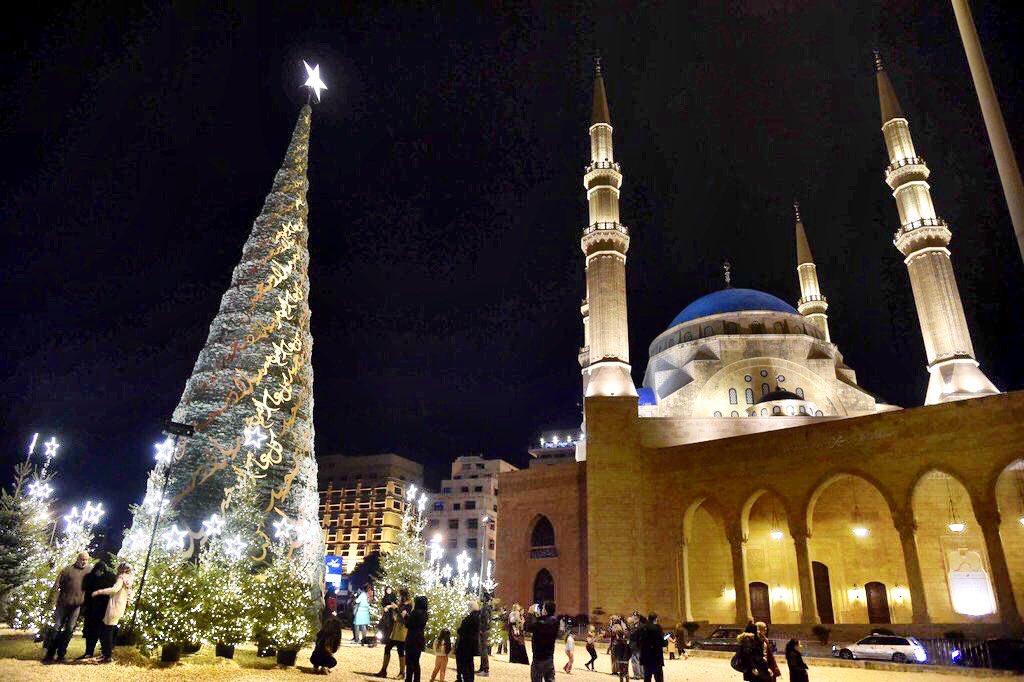
Editor's Note: What happened in Syria has not stayed in Syria. In 2014, Islamic State forces swept back into Iraq, and terrorism, sectarian tension, and fear have spread throughout much of the Middle East. One bit of good news is to be found in an unexpected place: Lebanon. The Middle East Institute's Paul Salem explains why, so far at least, Lebanon has survived the chaos emanating from Syria.
***
The small, divided, and weak state of Lebanon has survived the political, security, and refugee challenges of the Syrian maelstrom next door – at least so far. The political system has stalled, the economy has slowed, security has deteriorated, and sectarian tensions have increased, but state, society and economy have all persevered, and there has been no major implosion or explosion. I am frequently asked what some of the reasons for this surprising resilience are and from where might the major risks for Lebanon still come in the months and years ahead.
The first source of Lebanon’s resilience is the Taif Agreement of 1989. Taif established a way of sharing power through the political system and—although famously inefficient at decision-making—all the major factions have a share and stake in the political system. No major faction seeks to violently overthrow it. Lebanon’s civil wars in 1958 and 1975 were in large measure rebellions against the domination of one community—the Maronites—over the state. The civil wars in Syria, Iraq, Libya, and Yemen, are all also the result of basic and major denials of representation and inclusion in the state. To paraphrase and alter a famous political catchphrase, when it comes to major rebellions or civil wars, “It’s the politics, stupid.” In addition, the Lebanese state, while oligarchic, sectarian, and corrupt, presides over a fairly free, open, and pluralistic society with only limited levels of state repression. And while elections for parliament and president have been delayed for two years, all major positions in the state have been—and will be—ultimately decided by elections. There is a vibrant civil society movement that has protested to profoundly reform the system, but is a healthy force that maintains some pressure on the oligarchs and definitely does not threaten system collapse or civil war. The Lebanese political system is definitely in need of a raft of political reforms, but the basic inclusiveness of the system remains a key bulwark at least against serious civil conflict of the kind we see in several neighboring Arab countries. Indeed, until Syria and Iraq arrive at some agreed arrangement for representation and sharing of power in the state, with some measure of democratic accountability, they are not likely to see an end to civil conflict.

By Hugh Naylor - Washington Post
ZAHLE, Lebanon — Something remarkable is happening in this Lebanese farming town. Roads are no longer dark at night, and water is pumped to homes without interruption. There’s electricity here in Zahle, 24 hours a day, seven days a week.
And if you don’t think that’s a big deal, ask residents of just about any other town in this tiny country. They endure daily outages that can last 18 hours, so they pay exorbitant fees to opportunistic owners of private electricity generators to get enough power. In fact, millions of people across the Middle East are dealing with worsening power cuts. The issue fed the frustrations behind the Arab Spring revolts of 2011 and presents a daunting challenge for the region’s growing populations, including in war-torn countries such as Yemen and Iraq.
But in Zahle, a town of about 150,000 in Lebanon’s scenic Bekaa Valley, residents overcame energy woes with political will and creativity, offering the rest of the region possible lessons for a way to obtain reliable and affordable electricity.
نشرت بواسطة:Bitajarodفي أخبار خاصة 8 ساعات مضت 0

By catholicherald.co.uk
The deputy mayor of Nice has said that nuns wearing habits are no more welcome on his beaches than women wearing burkinis. Speaking to presenter Edward Stourton on the World at One on BBC Radio 4 yesterday, the Deputy Mayor, Rudy Salles defended the burkini ban and said: “What is the burkini? There is bikini and there is burka and the burka is forbidden. When you go to the beach you wear a bathing suit. You don’t go to the beach as you want. If I want to go on the beach naked it’s forbidden-I cannot.
“So if you want to go to the beach in a burkini it’s forbidden because it is a provocation. Religion and the state are completely separated. Religion is the affair of each one but each one at home, each one at church, not each one in the street.”
When Edward Stourton asked him: “What about a Catholic nun. Would she be allowed to appear on the beach wearing her habit?” The deputy mayor replied: “No. The same.”




Population Movements to Keserwan - The Khazens and The Maans
ما جاء عن الثورة في المقاطعة الكسروانية
ثورة أهالي كسروان على المشايخ الخوازنة وأسبابها
Origins of the "Prince of Maronite" Title
Growing diversity: the Khazin sheiks and the clergy in the first decades of the 18th century
Historical Members:
Barbar Beik El Khazen [English]
Patriach Toubia Kaiss El Khazen(Biography & Life Part1 Part2) (Arabic)
Patriach Youssef Dargham El Khazen (Cont'd)
Cheikh Bishara Jafal El Khazen
Patriarch Youssef Raji El Khazen
The Martyrs Cheikh Philippe & Cheikh Farid El Khazen
Cheikh Nawfal El Khazen (Consul De France)
Cheikh Hossun El Khazen (Consul De France)
Cheikh Abou-Nawfal El Khazen (Consul De France)
Cheikh Francis Abee Nader & his son Yousef
Cheikh Abou-Kanso El Khazen (Consul De France)
Cheikh Abou Nader El Khazen
Cheikh Chafic El Khazen
Cheikh Keserwan El Khazen
Cheikh Serhal El Khazen [English]
Cheikh Rafiq El Khazen [English]
Cheikh Hanna El Khazen
Cheikha Arzi El Khazen
Marie El Khazen