By
It may have been on the global radar for over a decade, but Lebanon’s fashion scene is having another moment. The country first stole international style headlines when designers like Elie Saab, Zuhair Murad, Reem Acra and Rabih Kayrouz began making couture gowns for Hollywood celebs. Elie Saab, Zuhair Murad, Rabih Kayrouz, a trio of Lebanese designers whose unique couture and ready-to-wear creations have taken the international fashion scene by storm.What is it like to live in a pressure cooker? If you want a real answer to that question, you might want to ask someone from Lebanon.
Although it is one of the Middle East’s most beautiful countries – after all, Beirut was known as the “Paris of the Middle East” in the 1970s – it has also been ravaged by war for decades. Beyond their heritage, these designers are tied together by a common thread: their creations are magically spun from glittering embroidery and embellishment. They truly create magic! The Middle East is known for its artisans and craftsmanship. They work on embroideries and hand works of all sorts. In Lebanon, we they’re a salad bowl of so many communities and each one specialized in some craft: from the Armenians to the Druze and to people in Saida or Tripoli or Baalbeck. There is so much to explore. Plus, they’re survivors. So they teach themselves skills and professions to stay afloat and that is an advantage!

BY Joseph A. Kechichian, Senior Writer - Gulf News
Beirut: Three years after the August 23, 2013 simultaneous bombings of Al Taqwa and Al Salam mosques in Tripoli that left 42 individuals dead and more than 600 injured, Judge Alaa Al Khatib issued a detailed indictment of two Syrian intelligence officers who apparently supervised the operations.
This condemnation is a first for the Lebanese judiciary, given that senior magistrates seldom complete their investigation due to political pressure. Judge Al Khatib identified the two Syrians by name — Mohammad Ali Ali, a captain serving in the Military Intelligence Brigade 235, also known as the Palestine Branch, and Nasser Juban, an official in the Political Security Division.
Arrest warrants for the two suspects were duly issued along with the establishment of a permanent investigation cell to uncover the identities of any senior officials who may have given orders and orchestrated the attack, whether they were foreign nationals or Lebanese citizens. Al Khatib, who delivered his 44-page report to Minister of Justice Ashraf Rifi, clarified that his investigations led to the orders that were issued by a senior security branch in the Syrian Intelligence, though he refrained to reveal that individual’s name.
Five Lebanese suspects were also indicted although only one suspect was charged for the crime, Yousuf Diab — who hails from Tripoli’s Jabal Mohsen — was arrested.
Reuters - Lebanon indicted
two Syrian intelligence officers on Friday in connection with twin
bombings at mosques in Tripoli in 2013, state media said, the deadliest
attack in the city since the end of Lebanon's civil war in 1990. The
two blasts, at the Sunni Muslim Taqwa and al-Salam mosques in the
northern Lebanese city, happened within minutes of each other in August
2013 and killed more than 40 people and injured hundreds. A
Lebanese military court accused Syrian intelligence officers Muhammad
Ali Ali, of the "Palestine Branch", and Nasser Jubaan, of the "Political
Security Directorate," of planning and overseeing the attacks,
Lebanon's National News Agency said. The
court ruling announcing the indictment said investigators were still
trying to uncover the names of the officials responsible for giving the
two officers their orders.

BRIH, Lebanon – It took more than three decades and an unexpected death to bring the village of Brih back together. Nestled among fruit trees and olive groves in a rugged valley, Brih was populated for generations by both Christians and Druze – adherents to a small but influential offshoot of Islam that emerged in the 11th century.
But when Lebanon descended into civil war in the 1970s, the two communities found themselves pitted against each other. In 1983, when the last Christians fled, Druze villagers moved into abandoned Christian houses; others were razed.
Then last November, Georges Chalhoub, a 56-year-old shopkeeper whose forefathers had come from Brih but who had lived near Beirut for much of his life, was killed in a car accident. Chalhoub had dreamed of moving back to his ancestral village and so his family decided to bury him there.
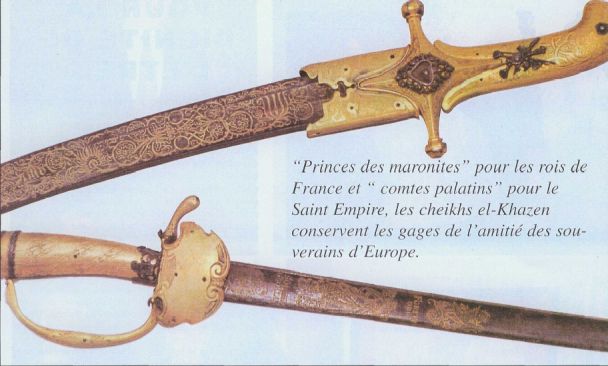
Population Movements to Keserwan - The Khazens and The Maans
ما جاء عن الثورة في المقاطعة الكسروانية
ثورة أهالي كسروان على المشايخ الخوازنة وأسبابها
Origins of the "Prince of Maronite" Title
Growing diversity: the Khazin sheiks and the clergy in the first decades of the 18th century
Historical Members:
Barbar Beik El Khazen [English]
Patriach Toubia Kaiss El Khazen(Biography & Life Part1 Part2) (Arabic)
Patriach Youssef Dargham El Khazen (Cont'd)
Cheikh Bishara Jafal El Khazen
Patriarch Youssef Raji El Khazen
The Martyrs Cheikh Philippe & Cheikh Farid El Khazen
Cheikh Nawfal El Khazen (Consul De France)
Cheikh Hossun El Khazen (Consul De France)
Cheikh Abou-Nawfal El Khazen (Consul De France)
Cheikh Francis Abee Nader & his son Yousef
Cheikh Abou-Kanso El Khazen (Consul De France)
Cheikh Abou Nader El Khazen
Cheikh Chafic El Khazen
Cheikh Keserwan El Khazen
Cheikh Serhal El Khazen [English]
Cheikh Rafiq El Khazen [English]
Cheikh Hanna El Khazen
Cheikha Arzi El Khazen
Marie El Khazen