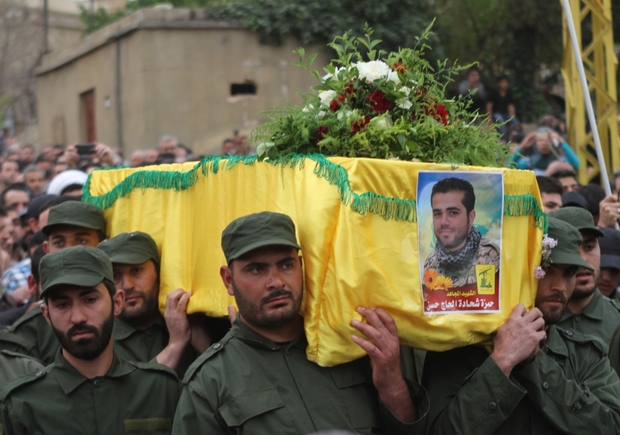
With a ceasefire now in effect after a months-long battle for the last Syrian rebel stronghold on the Lebanese border, Hezbollah has said it will stop fighting in Syria, a diplomatic source has told Lebanon’s Daily Star.
The unnamed source said the group informed Syrian authorities that once the fighting for Zabadani was over, it would end its combat in Syria where analysts say it has significantly strengthened pro-government forces since 2013.
In July, pro-government forces launched an offensive to try to recapture Zabadani, about 40km outside Damascus, which prompted a rebel alliance to besiege Fuaa and Kafraya, the only remaining government-held villages in Idlib province whose residents are Shia.
On Sunday, a ceasefire went into effect between pro-government forces and rebels in Zabadani in exchange for ceasefires in Fuaa and Kafraya.
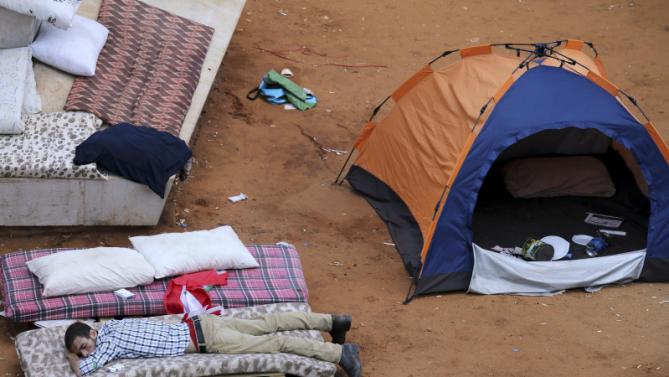
A Lebanese anti-government protester sleeps outside a tent set up for a sit-in against the ongoing garbage crisis and the government corruption, in front of the government house in downtown Beirut, Lebanon, Monday, Sept. 21, 2015
The Lebanese business community can’t have it both ways. Let me explain. Last Thursday, the Beirut Traders Association waded into the two-month dispute between the government and civil society activists, which began with the state’s inability to process Beirut’s rubbish, and then moved on to the wider issue of corruption, the absence of a president and the urgent need for parliamentary elections.
And what did the traders want? Well, basically they wanted the protesters to go home and rethink their strategy because, despite conceding that they did indeed have legitimate grievances, they were, as Nicolas Chammas, the association head, couched it, “voicing social demands at the expense of the economy”.
A full-page advertisement by the Hungarian government that was published in Lebanese newspapers, warning migrants not to enter the country illegally saying it is a crime punishable by imprisonment, in Beirut, Lebanon, Monday, Sept. 21, 2015. Hungary, which closed its border with Serbia on Sept. 15, erected another steel barrier at the Beremend border crossing from Croatia to try to slow the flow of migrants. But they kept coming. Lebanon has nearly 1.2 million Syrian refugees some of whom have expressed interest in migrating to Europe because of poor conditions they live in here. HUSSEIN MALLA — AP Photo
BEIRUT – The Hungarian government posted ads in Lebanese newspapers on Monday warning migrants not to enter illegally, saying it is a crime punishable by imprisonment.
In a full-page advertisement in several newspapers, including Lebanon's leading An-Nahar daily, the government said "the strongest possible action is taken" against people who attempt to enter Hungary illegally.
"Do not listen to the people smugglers. Hungary will not allow illegal immigrants to cross its territory," the advertisement reads in English and Arabic.
Lebanon has nearly 1.2 million Syrian refugees, some of whom have expressed interest in migrating to Europe because of dwindling aid and work opportunities.
Hungary, which closed its border with Serbia on Sept. 15, erected another steel barrier at the Beremend border crossing from Croatia to try to slow the flow of migrants. But they kept coming.

By Rageh Omaar - ITV
One of the books I read on Lebanon when I was first posted to the Middle East was called "A House of Many Mansions". I remember thinking what an intriguing and enigmatic title it was for a book about a country where the embers of a decades long civil war were still very much alive.
Written by the celebrated Lebanese historian Kamal Salibi, it is to this day, a title for the country which encapsulates the contradictions of Lebanon.




Population Movements to Keserwan - The Khazens and The Maans
ما جاء عن الثورة في المقاطعة الكسروانية
ثورة أهالي كسروان على المشايخ الخوازنة وأسبابها
Origins of the "Prince of Maronite" Title
Growing diversity: the Khazin sheiks and the clergy in the first decades of the 18th century
Historical Members:
Barbar Beik El Khazen [English]
Patriach Toubia Kaiss El Khazen(Biography & Life Part1 Part2) (Arabic)
Patriach Youssef Dargham El Khazen (Cont'd)
Cheikh Bishara Jafal El Khazen
Patriarch Youssef Raji El Khazen
The Martyrs Cheikh Philippe & Cheikh Farid El Khazen
Cheikh Nawfal El Khazen (Consul De France)
Cheikh Hossun El Khazen (Consul De France)
Cheikh Abou-Nawfal El Khazen (Consul De France)
Cheikh Francis Abee Nader & his son Yousef
Cheikh Abou-Kanso El Khazen (Consul De France)
Cheikh Abou Nader El Khazen
Cheikh Chafic El Khazen
Cheikh Keserwan El Khazen
Cheikh Serhal El Khazen [English]
Cheikh Rafiq El Khazen [English]
Cheikh Hanna El Khazen
Cheikha Arzi El Khazen
Marie El Khazen