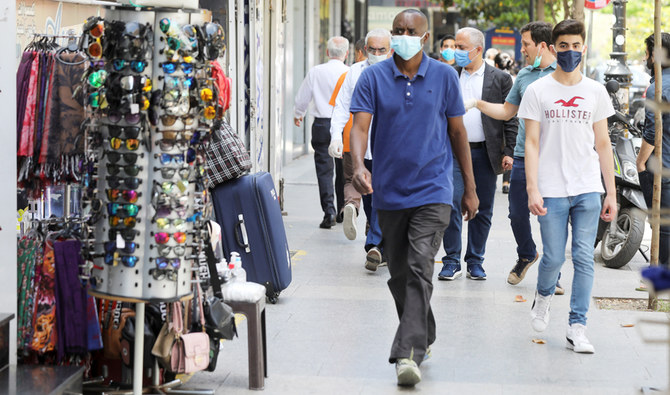
by arabnews.com -- NAJIA HOUSSARI -- BEIRUT: The end of Lebanon’s four-day lockdown on Monday saw citizens flood to shops, banks, cafes, and places of work amid government fears that ignoring social distancing guidelines could have serious “consequences” for the country. Pressures caused by the economic crisis and collapse of the Lebanese pound forced the decision to reopen the country for business a week before Eid Al-Fitr, despite random testing for the coronavirus disease (COVID-19) detecting new cases in the capital Beirut and elsewhere. Prime Minister Hassan Diab said: “Each of us must take responsibility for himself.” Monday also witnessed a resumption of virtual talks between the Lebanese government and representatives of the International Monetary Fund aimed at easing the country’s dire financial situation. As the latest session of negotiations took place protesters returned to the streets to carry on their anti-government demonstrations, with sit-ins taking place outside the Palace of Justice in Beirut, the Ministry of Economy, and the Ministry of Social Affairs.
Many Lebanese emerging from the four-day curfew were reported not to be complying with government requests to wear a face mask and apply social distancing rules to avoid any further spread of COVID-19. Assem Araji, head of Lebanon’s parliamentary health committee, told Arab News: “Continuing to close the country is no longer useful in light of the suffocating economic crisis and the collapse of the Lebanese pound. “The country had to be reopened because the people want to eat and the unemployment rate touched 70 percent, according to the Ministry of Social Affairs. “The condition for this return to work was the commitment to preventive measures, but people seem not to want to comply and we cannot put a soldier for every citizen to force them to comply. It is the responsibility of individuals to take care of themselves, their families and all who come into contact with them, and I fear that recklessness will lead to consequences.”
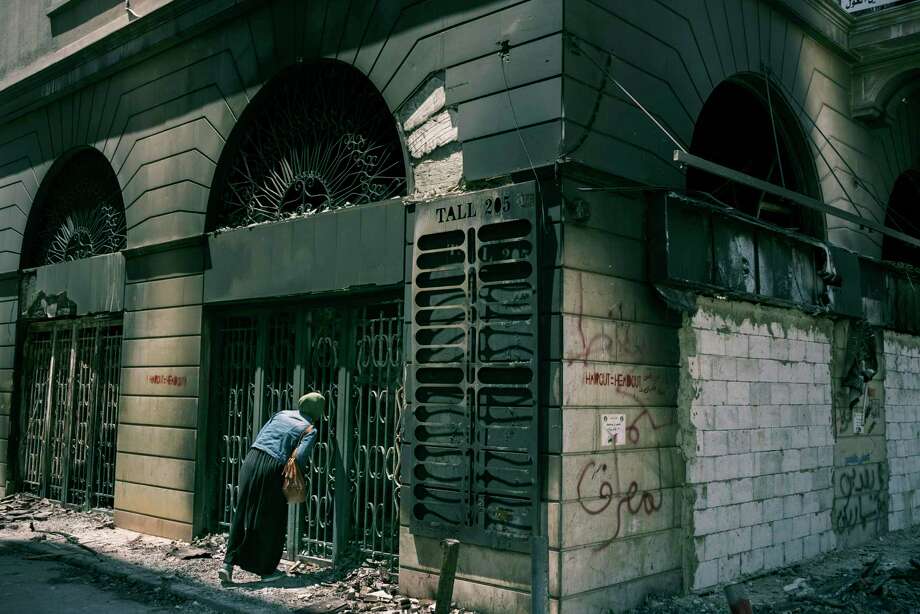
Sarah Dadouch, The Washington Post -- BEIRUT - The Lebanese love their food. Their elaborate spreads of grilled and sauteed meats, colorful salads and various vegetable dips, usually garnished with pine nuts, are a source of pride and the shared meals a symbol of generosity. Today, more than ever, food is on everyone's mind - because there is so little to be had. From the butchers and taxi drivers of Beirut to the aficionados of Tripoli's famed sweets to the anti-government protesters in the streets, hunger is on everyone's tongue. Lebanon's escalating economic crisis and its collapsing currency are putting the price of many foodstuffs beyond the reach of the Lebanese. The price of meat, for example, has doubled since March, with ground beef now running at about $9 a pound.
Mustafa, a 73-year-old butcher in Beirut, said the same customer has been calling him every other day for weeks asking whether the prices have dropped: "He calls and says, 'No, that's expensive,' and hangs up. But it's only getting more expensive." Mustafa who out of fear declined to give his full name, said he no longer bothers updating his price list. Rarely does a Lebanese meal lack tomatoes - minuscule cubes hiding among parsley and bulgur in tabbouleh salad, or stewed with onions and garlic, a base for countless other dishes - but tomato prices have also doubled.
Shoppers who used to haul away kilogram after kilogram of tomatoes without a second thought are rationing, buying half a kilo or a few tomatoes at a time, said one grocer, shaking his head in disbelief. And in the northern city Tripoli, which is known for its sweets - the most famous featuring semolina-and-cheese dough wrapped around clotted cream and drizzled with orange-blossom syrup - and where desserts are never an afterthought, the city's most famous confectioner, Hallab, was uncharacteristically empty. Even though it was Ramadan, when an evening meal usually lasts for hours and ends with the family gathering around the television with tea or coffee and a flaky or creamy dessert, there was no holiday rush. "We can't even buy dessert," Um Ahmed, a Tripoli resident, said wearily. "The dessert shops are open, but there's no money." "Well, there are those who have money," her husband, Abu Ahmed, said sarcastically, "such as our ministers and MPs - may God protect them."

by Sunniva Rose - thenational.ae --The wife of Lebanese Prime Minister Hassan Diab has come under fire for suggesting nationals could take low-skilled jobs traditionally held by migrant workers, including as domestic workers or janitors. Nuwar Mawlawi's comments come as the country faces a dire economic crisis and soaring unemployment and povertyyet where many unskilled or semi-skilled jobs are almost exclusively held by foreign nationals. "We could dispense with migrant workers," Ms Mawlawi told state-run Radio Lebanon on Friday. "Women sitting at home could work in homes. That is a simple example. Janitors, fuel stations jobs would be for locals." Her comments sparked debate on social media with some supporting her comments, while others used the derogatory hashtag "Hassan, control your wife". "All governments in the world are trying to improve the conditions of their people except for Hassan Diab's wife," one user tweeted. "She wants girls and women to work as maids and housekeepers." Like many who expressed outrage at Ms Mawlawi's words, the user told of his allegiance to Mr Diab's predecessor and fierce critic, Saad Hariri.
Mr Diab's office defended Mrs Mawlawi, saying she meant that the "Lebanese must depend on themselves in light of the difficult economic conditions that Lebanon is going through". She declined to comment on the debate. Economist and former labour minister Charbel Nahas said the suggestion that Lebanese could take low-skilled jobs is a deeply held taboo. "Ms Mawlawi's words may be glaringly obvious but they hurt the sense of superiority of the Lebanese," Mr Nahas told The National.
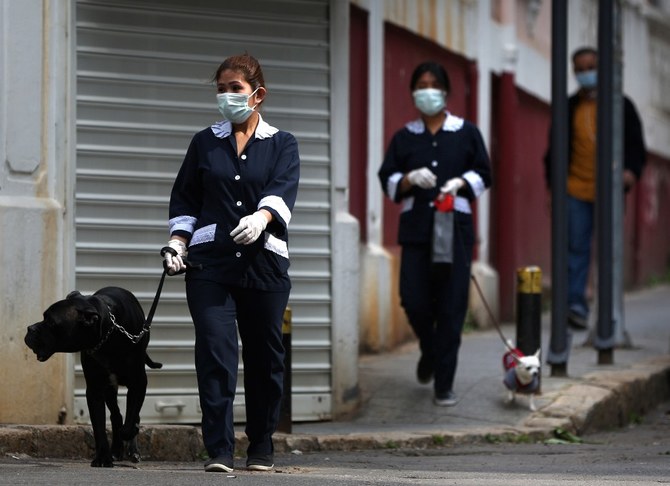
by arabnews.com -- NAJIA HOUSSARI -- BEIRUT: Foreign workers in Lebanon are seeking repatriation because the country’s dire economic situation has left employers unable to pay them. Many Lebanese people have ditched their foreign domestic help to avoid the cost of repatriating them to their home countries, or returned them to the employment agencies they were recruited from. Domestic workers have also run away after employers stopped paying their salaries, seeking refuge in the embassies of their home countries in their bid to be evacuated. There are more than 150,000 foreigners working legally in Lebanon, and 80,000 working illegally. “We received videotapes of the detention of some 26 Filipino female workers, including a pregnant woman, in a building adjacent to their country’s embassy in the Hadath area in the southern suburb of Beirut more than 35 days ago,” Bassam Kantar, a member of Lebanon’s National Human Rights Commission, which includes the Committee for the Prevention of Torture (LNHRC-CPT), told Arab News. “They were kept in a room in poor conditions. We visited the embassy and talked to the officials. There are more than 100 other workers inside the consulate awaiting repatriation.”
Kantar said that the LNHRC-CPT had been contacted by other foreigners requesting repatriation, especially those who were working illegally. “The LNHRC-CPT contacted Lebanese General Security and it decided to exempt the employees from paying the residency allowance and fines. But it is unable to return them to their countries because it is the responsibility of their embassies.” He said that there was cooperation between the International Organization for Migration and Lebanese General Security to transfer such workers through planes belonging to airlines of other countries that were carrying workers of other nationalities. Some airlines refused to send empty planes to Lebanon due to huge losses, he said, but explained the biggest problem related to workers from countries with which Lebanon had no diplomatic relations.



Population Movements to Keserwan - The Khazens and The Maans
ما جاء عن الثورة في المقاطعة الكسروانية
ثورة أهالي كسروان على المشايخ الخوازنة وأسبابها
Origins of the "Prince of Maronite" Title
Growing diversity: the Khazin sheiks and the clergy in the first decades of the 18th century
Historical Members:
Barbar Beik El Khazen [English]
Patriach Toubia Kaiss El Khazen(Biography & Life Part1 Part2) (Arabic)
Patriach Youssef Dargham El Khazen (Cont'd)
Cheikh Bishara Jafal El Khazen
Patriarch Youssef Raji El Khazen
The Martyrs Cheikh Philippe & Cheikh Farid El Khazen
Cheikh Nawfal El Khazen (Consul De France)
Cheikh Hossun El Khazen (Consul De France)
Cheikh Abou-Nawfal El Khazen (Consul De France)
Cheikh Francis Abee Nader & his son Yousef
Cheikh Abou-Kanso El Khazen (Consul De France)
Cheikh Abou Nader El Khazen
Cheikh Chafic El Khazen
Cheikh Keserwan El Khazen
Cheikh Serhal El Khazen [English]
Cheikh Rafiq El Khazen [English]
Cheikh Hanna El Khazen
Cheikha Arzi El Khazen
Marie El Khazen