by middleeasteye.net -- Belen Fernandez -- During the noisy aftermath of a basketball game in Beirut a couple of years ago, I asked my Lebanese companion when the sport had become popular in Lebanon. "When we discovered we could make it sectarian," he joked. Now, the occasion has again arisen to contemplate themes of sectarianism and athletics in the context of a short documentary film titled Lebanon Wins the World Cup, originally released in 2015 but currently available for free streaming on Vimeo for the duration of this year's World Cup competition.
Football and war The title is indeed fitting; after all, if you've ever experienced a World Cup in Lebanon, you're likely to have assumed the Lebanese won the whole darn thing based on the amount of horn-honking, flag-waving, and general ruckus that transpires. This is particularly the case following a win by Germany or Brazil, both of which play host to sizable Lebanese populations. The film's synopsis reads: "On the eve of the 2014 FIFA World Cup, two former enemies from the Lebanese civil war prepare to support their favourite team Brazil. Can the tournament unite them despite everything that's gone wrong?"
The title is indeed fitting; after all, if you've ever experienced a World Cup in Lebanon, you're likely to have assumed the Lebanese won the whole darn thing based on the amount of horn-honking, flag-waving, and general ruckus that transpires. This is particularly the case following a win by Germany or Brazil, both of which play host to sizable Lebanese populations. The film's synopsis reads: "On the eve of the 2014 FIFA World Cup, two former enemies from the Lebanese civil war prepare to support their favourite team Brazil. Can the tournament unite them despite everything that's gone wrong?" The duo consists of Edward Chamoun, a former fighter with the right-wing Christian Lebanese Forces, and Hassan Berri, a Shia Muslim who fought with the Lebanese Communist Party for several years of the conflict, which lasted from 1975-1990. The film spotlights their individual reflections on life and war, and then follows them as they meet in Beirut to root for Brazil. The answer to the question of whether or not the tournament can unite them isn’t difficult to predict. Both men, it turns out, had supported Brazil in the 1982 World Cup, which took place in the middle of the Lebanese civil war and overlapped with Israel’s summer invasion of Lebanon, a devastating affair that killed some 20,000 people, the majority of them civilians. Recalls Berri: "Your country is being invaded, it's under attack. And imagine, all I could think about was a game." Hooking up a car battery to a small television, he and his comrades tuned into the Italy-Brazil match, at which point the bombing suddenly stopped: "It was as if the Israeli Army wanted to watch the match too." Lebanon clearly didn’t win that World Cup, and neither did Brazil, with victory instead going to the Italians - who incidentally also won the 2006 World Cup, which concluded a few days prior to the launch of Israel’s bloody 34-day assault on Lebanon. Some might therefore view Italy’s failure to qualify this year as reassuring.
BEIRUT, (Xinhua) — Lebanon’s Parliament Speaker Nabih Berri warned on Monday that the country’s economy will deteriorate if the new government is not …
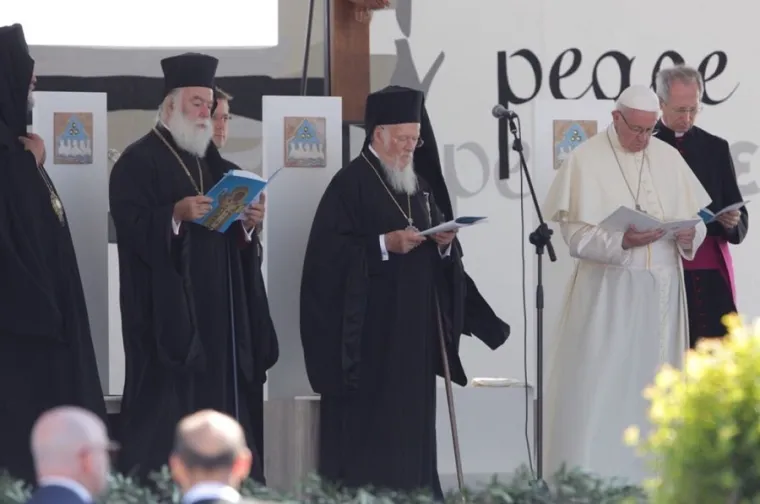
By Elise Harris Vatican City (CNA/EWTN News).- Joined by heads of Christian Churches in the Middle East, Pope Francis Saturday condemned the “complicit silence” and indifference of the world to the conflicts tearing the region apart, and urged Christians to pray for peace. “Indifference kills, and we desire to lift up our voices in opposition to this murderous indifference,” the pope said July 7. As Christians, “we want to give a voice to those who have none, to those who can only wipe away their tears,” he said. “For the Middle East today is weeping, suffering and silent as others trample upon those lands in search of power or riches.” “On behalf of the little ones, the simple ones, the wounded, and all those at whose side God stands, let us beg, 'Let there be peace!'” Pope Francis spoke at the opening of a prayer encounter during his July 7 daytrip to Bari for an ecumenical gathering of patriarchs and heads of Christian churches in the Middle East, which holds the theme “Peace be upon you! Christians together for the Middle East.” Located in the southern Italian region of Puglia, Bari is known as the “porta d’Oriente,” or the “Eastern Gate,” because of its connection to both the Catholic and Orthodox Churches through the relics of St. Nicholas, who is highly venerated in both traditions. The ecumenical gathering in Bari drew the participation of some 19 leaders of Eastern Catholic Churches and Orthodox Churches, the Assyrian Church of the East, as well as ecclesial communities. Upon his arrival, the pope was greeted by local authorities before heading to the Basilica of St. Nicholas, where he personally greeted the 19 patriarchs who came to the event and venerated the relics of the saint alongside them in the basilica's crypt.
After the prayer gathering, the pope and ecumenical leaders will return to the Basilica of St. Nicholas for a closed-door meeting opened by Archbishop Pierbattista Pizzaballa, apostolic administrator of the Latin Patriarchate of Jerusalem. The group will then have lunch before Francis heads back to Rome. In his address during the prayer gathering, Pope Francis said veneration of St. Nicholas “crosses seas and bridges boundaries between Churches,” and prayed that the saint would intercede “to heal the wounds that so many people bear within them.” The Middle East, he said, is the place where Jesus lived and died, and is therefore the place where “the light of faith spread throughout the world.” However, despite the rich monastic and cultural traditions in the region, the Middle East has been overshadowed by “dark clouds of war, violence and destruction, instances of occupation and varieties of fundamentalism, forced migration and neglect,” Francis said, noting that all this has taken place “amid the complicit silence of many.” The Middle East, he said, “has become a land of people who leave their own lands behind. There is also the danger that the presence of our brothers and sisters in the faith will disappear, disfiguring the very face of the region. For a Middle East without Christians would not be the Middle East.” Francis recalled how at the beginning of the day, while the heads of churches were praying in front of the relics of St. Nicholas, he lit an oil lamp with a single flame as a symbol of unity. As Christians, “we want to kindle a “flame of hope” in the Middle East, he said, and prayed that light from this and additional lamps lit during the prayer gathering would be a sign of the light that continues to shine in darkness. “Christians are the light of the world not only when everything is bright around them, but also when, in dark moments of history, they refuse to be resigned to the encircling gloom but instead feed the wick of hope with the oil of prayer and love,” he said.

Population Movements to Keserwan - The Khazens and The Maans
ما جاء عن الثورة في المقاطعة الكسروانية
ثورة أهالي كسروان على المشايخ الخوازنة وأسبابها
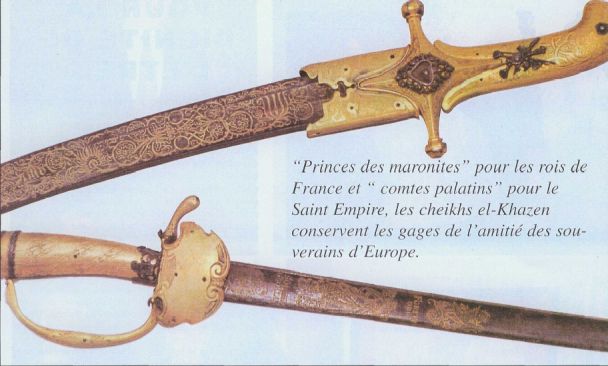
Origins of the "Prince of Maronite" Title
Growing diversity: the Khazin sheiks and the clergy in the first decades of the 18th century
Historical Members:
Barbar Beik El Khazen [English]
Patriach Toubia Kaiss El Khazen(Biography & Life Part1 Part2) (Arabic)
Patriach Youssef Dargham El Khazen (Cont'd)
Cheikh Bishara Jafal El Khazen
Patriarch Youssef Raji El Khazen
The Martyrs Cheikh Philippe & Cheikh Farid El Khazen
Cheikh Nawfal El Khazen (Consul De France)
Cheikh Hossun El Khazen (Consul De France)
Cheikh Abou-Nawfal El Khazen (Consul De France)
Cheikh Francis Abee Nader & his son Yousef
Cheikh Abou-Kanso El Khazen (Consul De France)
Cheikh Abou Nader El Khazen
Cheikh Chafic El Khazen
Cheikh Keserwan El Khazen
Cheikh Serhal El Khazen [English]
Cheikh Rafiq El Khazen [English]
Cheikh Hanna El Khazen
Cheikha Arzi El Khazen
Marie El Khazen