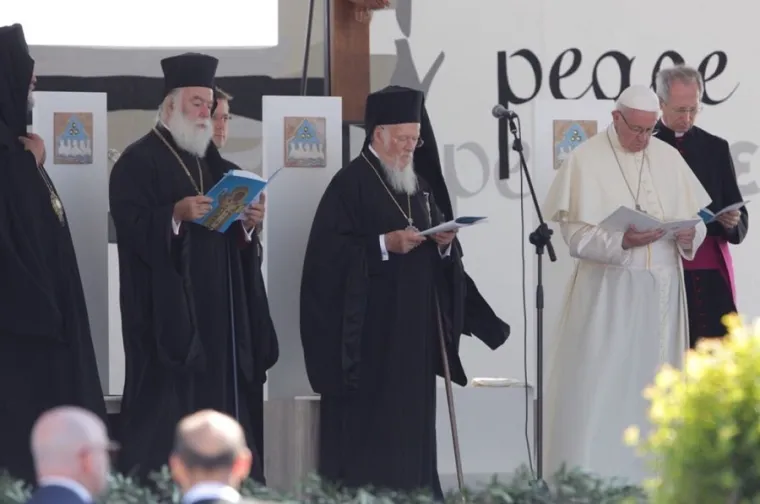
By Elise Harris Vatican City (CNA/EWTN News).- Joined by heads of Christian Churches in the Middle East, Pope Francis Saturday condemned the “complicit silence” and indifference of the world to the conflicts tearing the region apart, and urged Christians to pray for peace. “Indifference kills, and we desire to lift up our voices in opposition to this murderous indifference,” the pope said July 7. As Christians, “we want to give a voice to those who have none, to those who can only wipe away their tears,” he said. “For the Middle East today is weeping, suffering and silent as others trample upon those lands in search of power or riches.” “On behalf of the little ones, the simple ones, the wounded, and all those at whose side God stands, let us beg, 'Let there be peace!'” Pope Francis spoke at the opening of a prayer encounter during his July 7 daytrip to Bari for an ecumenical gathering of patriarchs and heads of Christian churches in the Middle East, which holds the theme “Peace be upon you! Christians together for the Middle East.” Located in the southern Italian region of Puglia, Bari is known as the “porta d’Oriente,” or the “Eastern Gate,” because of its connection to both the Catholic and Orthodox Churches through the relics of St. Nicholas, who is highly venerated in both traditions. The ecumenical gathering in Bari drew the participation of some 19 leaders of Eastern Catholic Churches and Orthodox Churches, the Assyrian Church of the East, as well as ecclesial communities. Upon his arrival, the pope was greeted by local authorities before heading to the Basilica of St. Nicholas, where he personally greeted the 19 patriarchs who came to the event and venerated the relics of the saint alongside them in the basilica's crypt.
After the prayer gathering, the pope and ecumenical leaders will return to the Basilica of St. Nicholas for a closed-door meeting opened by Archbishop Pierbattista Pizzaballa, apostolic administrator of the Latin Patriarchate of Jerusalem. The group will then have lunch before Francis heads back to Rome. In his address during the prayer gathering, Pope Francis said veneration of St. Nicholas “crosses seas and bridges boundaries between Churches,” and prayed that the saint would intercede “to heal the wounds that so many people bear within them.” The Middle East, he said, is the place where Jesus lived and died, and is therefore the place where “the light of faith spread throughout the world.” However, despite the rich monastic and cultural traditions in the region, the Middle East has been overshadowed by “dark clouds of war, violence and destruction, instances of occupation and varieties of fundamentalism, forced migration and neglect,” Francis said, noting that all this has taken place “amid the complicit silence of many.” The Middle East, he said, “has become a land of people who leave their own lands behind. There is also the danger that the presence of our brothers and sisters in the faith will disappear, disfiguring the very face of the region. For a Middle East without Christians would not be the Middle East.” Francis recalled how at the beginning of the day, while the heads of churches were praying in front of the relics of St. Nicholas, he lit an oil lamp with a single flame as a symbol of unity. As Christians, “we want to kindle a “flame of hope” in the Middle East, he said, and prayed that light from this and additional lamps lit during the prayer gathering would be a sign of the light that continues to shine in darkness. “Christians are the light of the world not only when everything is bright around them, but also when, in dark moments of history, they refuse to be resigned to the encircling gloom but instead feed the wick of hope with the oil of prayer and love,” he said.

by newsweek.com - TOM O'CONNOR -- Lebanon's economic minister has endorsed a plan to revitalize the country's struggling economy—and it includes capitalizing on one of Lebanon's best known, yet entirely illegal products. In an interview with Bloomberg News, Lebanese Caretaker Economy and Trade Minister Raed Khoury discussed Friday a plan devised by New York-based global consulting firm McKinsey & Company to diversify the country's economy as it faces a deepening financial crisis. The plan reportedly included potential "quick wins" such as getting involved in reconstruction efforts for conflict-ridden Iraq and Syria, investing in the tourism sector and legalizing Lebanon's illicit cannabis farms for medicinal exports. "The quality we have is one of the best in the world," Khoury told the outlet, adding that the cannabis had the potential to bring in up to a billion dollars.
The Lebanese government has long struggled to crack down on the cannabis growers in the Bekaa Valley, an eastern territory bordering Syria and largely under the influence of the Shiite Muslim Hezbollah movement. The powerful Iran-backed political and paramilitary group has routinely denied any ties to the region's booming drug industry, but independent farmers are still well armed and the region's lawlessness has only increased with the outbreak of conflict in neighboring Syria. In March 2017, hashish farm operator Ali Nasri Shamas openly discussed his business with BBC News. "Just like Europe and the U.S. export terrorism to us, we sell them drugs," Shamas told the station as he showed off large supplies of weapons and drugs. Local outlets such as Stepfeed and the 961 soon reported raids on his properties by Lebanon's Internal Security Forces, turning up a generous amount of loot.
The Daily Star BEIRUT: An Egyptian court Saturday sentenced a Lebanese woman accused of “insulting Egypt and attacking religion” to eight years …
Customers buy peaches during Bikfaya Peach Festival in Bikfaya. The Bikfaya Peach Festival is an annual event which Lebanese are waiting for, …




Population Movements to Keserwan - The Khazens and The Maans
ما جاء عن الثورة في المقاطعة الكسروانية
ثورة أهالي كسروان على المشايخ الخوازنة وأسبابها
Origins of the "Prince of Maronite" Title
Growing diversity: the Khazin sheiks and the clergy in the first decades of the 18th century
Historical Members:
Barbar Beik El Khazen [English]
Patriach Toubia Kaiss El Khazen(Biography & Life Part1 Part2) (Arabic)
Patriach Youssef Dargham El Khazen (Cont'd)
Cheikh Bishara Jafal El Khazen
Patriarch Youssef Raji El Khazen
The Martyrs Cheikh Philippe & Cheikh Farid El Khazen
Cheikh Nawfal El Khazen (Consul De France)
Cheikh Hossun El Khazen (Consul De France)
Cheikh Abou-Nawfal El Khazen (Consul De France)
Cheikh Francis Abee Nader & his son Yousef
Cheikh Abou-Kanso El Khazen (Consul De France)
Cheikh Abou Nader El Khazen
Cheikh Chafic El Khazen
Cheikh Keserwan El Khazen
Cheikh Serhal El Khazen [English]
Cheikh Rafiq El Khazen [English]
Cheikh Hanna El Khazen
Cheikha Arzi El Khazen
Marie El Khazen