CI has also affirmed the ‘B’ foreign currency issue ratings and ‘Stable’ Outlook assigned to Lebanon’s $3 billion global notes issued in three tranches ($1.25 billion due in 2027; $1 billion due in 2032; and $0.75 billion due in 2037) earlier this year. The ratings’ affirmation reflects the relative stabilisation of domestic political risk factors following the end of a two-year political stalemate and the endorsement of an electoral law that is expected to pave the way for parliamentary elections in May 2018. The policymaking environment has also improved, with parliament recently passing the annual draft budget law for the first time in a decade. The ratings affirmation also takes into account Lebanon’s stable buffer of foreign exchange reserves, which provide adequate coverage of the country’s external debt.
Lebanon’s ratings are fundamentally supported by: adequate international liquidity; a remarkably reliable (though undiversified) investor base and strong donor support; and an unblemished record of meeting debt obligations, even during difficult times. The ratings are constrained by: heavy indebtedness and large financing needs; a weak budget structure and limited fiscal flexibility; socio-economic challenges; the slow pace of economic and fiscal reforms; and local and regional political risks. Economic activity has picked up modestly in 2017 but remains relatively weak, with real GDP growth expected to reach around 2.1 per cent, driven by domestic consumption and a rebound in tourism. The short to medium-term outlook has improved slightly, supported by the prospect of a more stable domestic political climate and efforts to restore relations with GCC member states in order to attract tourism, inward investment and boost expatriate employment.
As a result, CI expects real GDP growth to increase to 2.4 per cent in 2018-2019. On the downside, the conflict in Syria continues to weigh heavily on the performance and stability of the Lebanese economy. The influx of refugees, who now comprise around one-third of the population, is placing significant pressure on the country’s limited resources and creating significant social challenges. The public finances remain weak, with the central government budget deficit expected to decrease to 7.9 per cent of GDP in 2017 from 9.7 per cent in 2016 due to a decline in the treasury transfers to municipalities. The primary budget surplus is expected to improve to 1.8 per cent of GDP in 2017, compared to less than 0.1 per cent in 2016, as the government has managed to secure its financing needs at more favourable rates. Public debt remains high and is expected at around 148 per cent of GDP in 2017. Refinancing risk remains significant, with the government’s gross financing requirement likely to exceed 35 per cent of GDP in 2017.
WAM (Emirates News Agency) – BEIRUT- Commander of the Lebanese Armed Forces, General Joseph Khalil Aoun, has praised the critical and constructive …


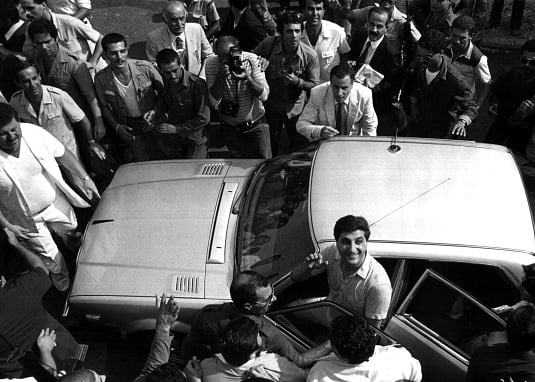
khazen.org congratulate court decision for sentencing the criminal and terrorist Habib Shartouni and Nabil Al Alam to death.
BEIRUT (Reuters) - Lebanon's top court on Friday sentenced Habib Shartouni to death for the 1982 assassination of president-elect Bashir Gemayel, an event that was a turning point in Lebanon's 15-year civil war. Shartouni, a member of the Syrian Socialist Nationalist Party (SSNP), admitted his part in the bombing in the 1980s and was tried in absentia after escaping from prison in 1990 following eight years in detention.
The Judicial Council, Lebanon's highest state security court, on Friday sentenced Habib Chartouni and Nabil al-Alam to death in absentia in the case of the 1982 assassination of President-elect Bashir Gemayel. The Council also stripped Syrian Social National Party members Chartouni and Alam of their civil rights. The in absentia trial had kicked off on November 25, 2016. During that session, the Judicial Council called on Chartouni -- who confessed to planting the bomb before escaping prison -- to turn himself in. It also decided to launch in absentia proceedings against the other suspect in the case, al-Alam, after media reports said he had died of illness in Brazil in 2014.
L'orient-lejour -Le 14 septembre 1982, Bachir Gemayel, élu président de la République 22 jours plus tôt, est assassiné peu après 16 heures dans une explosion qui détruit les locaux de la permanence du parti Kataëb dans le quartier beyrouthin d'Achrafieh. L'attentat coûte la vie au fondateur des Forces libanaises et à 32 autres personnes. Vendredi 20 octobre 2017, la Cour de justice, présidée par Jean Fahd, condamne à mort Habib Chartouni, militant du Parti syrien national social (PSNS, pro-Assad), et Nabil Alam, ancien haut responsable du PSNS, pour l'organisation et l'exécution de cet assassinat.Retour, 35 ans après sa mort, sur la vie de Cheikh Bachir, dont l'héritage politique perdure jusqu'à aujourd'hui.
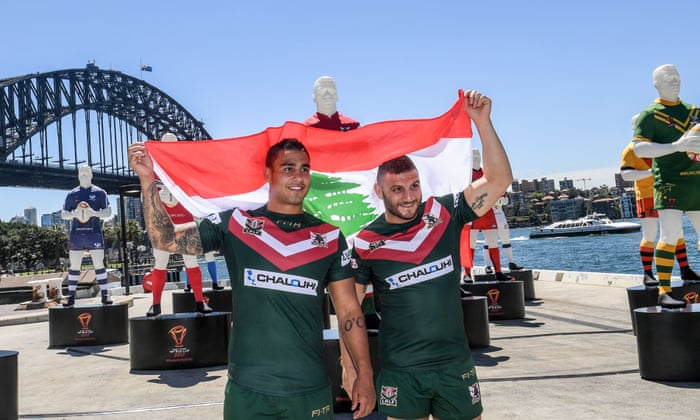
by Joe Gorman - The guardian - Every rugby league season for the past few years, Chris Saab has worked long hours at his earthmoving business during the day, trained three nights a week, and given up weekends to play in Sydney’s Ron Massey Cup. At 35 years of age, he is physically and mentally ready to retire. In fact he was ready to call it a day back in 2015, after helping the Lebanese national team qualify for their second Rugby League World Cup. But the lure of playing with his best friend, Robbie Farah, convinced him otherwise. “He’s getting on in his career,” explains Farah. “I know at times he’s thought about giving the game away, but in the back of his mind has been wanting to be a part of this World Cup. It’s going to be one of the highlights of my career to play alongside him. I made my debut for Lebanon as an 18-year-old, as did he, and we’ve been best mates ever since. Our careers since then have gone down different paths, and we haven’t been able to play alongside each other since that first game.” While Farah went on to win a NRL premiership and play State of Origin for New South Wales, Saab lived out a journeyman career in Sydney’s lower grades. He gave up on his dream of playing in the NRL years ago. He only continued playing at all, he said, “because I want to play for Lebanon and I wanted to qualify for the World Cup”. Rugby league’s flexible eligibility rules have been a major talking point of the 2017 World Cup. The rules allow players such as Farah, who has previously represented Australia, to switch to a tier two nation such as Lebanon. Already Andrew Fifita has controversially defected to Tonga after being selected for the Kangaroos.
Opinion is divided between those who believe these rules turn the tournament into a gimmick, and those who believe they are essential to grow the game internationally. Many of the nations that have qualified for this year’s tournament are filled with Australians. When the Kangaroos play Lebanon in Sydney, for example, it will almost be like Australia “A” versus Australia “B” as NRL stars such as Farah, Mitchell Moses and Tim Mannah line up for the Cedars. “There’s a fair bit of pride in those players for their upbringing and their parents, and some of the hardships that their families went through in the early years when they migrated to this country,” said Tas Baitieri, a development officer for the Rugby League International Federation. “A lot do it out of respect. And you know, having a bit of respect isn’t a bad thing for young people today.”
The story of Saab is just one example. His father, Joe, migrated to Australia with just a couple of dollars in his pocket and a suitcase full of clothes. He never wanted his son to play rugby league. “I started playing footy when I was seven,” explains Saab. “I think it was an Under-10s or Under-12s game, my father came to watch and I got a massive cork in my leg. I was on the floor crying, and my dad jumped the fence. He was a massive guy – six foot seven – and he actually put me on his shoulder, pushed the trainer out of the way and carried me off the field. Since then he wasn’t real keen on the footy thing. Still, when Saab debuted for Lebanon in a Test match against France in 2002, his father travelled to Tripoli to watch him play. The Cedars won 36-6 and Joe was converted. “That was the first time he’d been back to see his sister and his family in 33 years,” says Saab.
Population Movements to Keserwan - The Khazens and The Maans
ما جاء عن الثورة في المقاطعة الكسروانية
ثورة أهالي كسروان على المشايخ الخوازنة وأسبابها
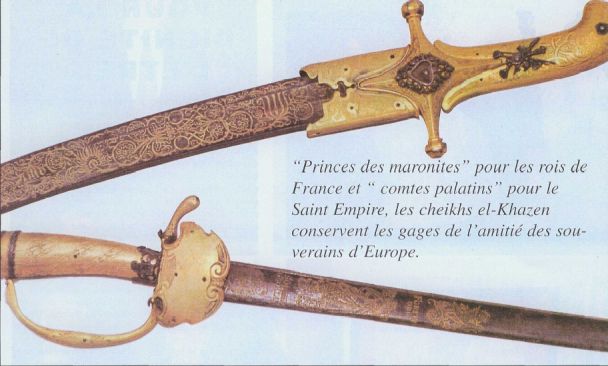
Origins of the "Prince of Maronite" Title
Growing diversity: the Khazin sheiks and the clergy in the first decades of the 18th century
Historical Members:
Barbar Beik El Khazen [English]
Patriach Toubia Kaiss El Khazen(Biography & Life Part1 Part2) (Arabic)
Patriach Youssef Dargham El Khazen (Cont'd)
Cheikh Bishara Jafal El Khazen
Patriarch Youssef Raji El Khazen
The Martyrs Cheikh Philippe & Cheikh Farid El Khazen
Cheikh Nawfal El Khazen (Consul De France)
Cheikh Hossun El Khazen (Consul De France)
Cheikh Abou-Nawfal El Khazen (Consul De France)
Cheikh Francis Abee Nader & his son Yousef
Cheikh Abou-Kanso El Khazen (Consul De France)
Cheikh Abou Nader El Khazen
Cheikh Chafic El Khazen
Cheikh Keserwan El Khazen
Cheikh Serhal El Khazen [English]
Cheikh Rafiq El Khazen [English]
Cheikh Hanna El Khazen
Cheikha Arzi El Khazen
Marie El Khazen