BEIRUT (Reuters) - Lebanon can no longer handle vast numbers of Syrian refugees, its president said on Monday, urging world powers to help them return to the calmer parts of their war-torn homeland. More than six years into the Syrian war, 1.5 million refugees who fled the violence now account for a quarter of Lebanon's population. Lebanese President Michel Aoun told international envoys he wanted to find ways for them to return safely but would not force people back to places where they could face persecution. "My country cannot handle it anymore," Aoun told representatives of the European Union, the Arab League and the five permanent members of the U.N. Security Council at a meeting in Beirut, his media office said.
The long-term presence of refugees is a particularly sensitive issue in Lebanon where some politicians say the influx of mainly Sunni Syrians might destabilize the delicate sectarian balance with Christians, Shi'ite Muslims and others. As the Syrian government regains more territory from rebels and militants, calls have increased in Lebanon for Syrians to return. A series of ceasefire deals has reduced fighting to some extent in parts of western Syria. But rights groups have warned against forcing people back to a country still at war, and refugees have often said they fear facing arrest or conscription into the army. The U.N. refugee agency does not yet consider Syria safe for refugee to return to. Lebanese Prime Minister Saad al-Hariri has said there can be no forced returns. Aoun told the envoys there were parts of Syria not currently at war and territory where calm has returned, a spokesman said. "The return of displaced to stable and low-tension areas must be carried out without attaching it to reaching a political solution," the president's Twitter account said. Aoun said it was in the everyone's interest to solve the refugee crisis so that political, economic and social problems in Lebanon do not get out of hand. Officials at the meeting thanked Lebanon for its generosity in hosting refugees. "They expressed their full understanding of the concerns that are being voiced," a statement from the envoys said. "A return of refugees to their country of origin must take place in safety, dignity and voluntarily, in accordance with principles of international law," it said. (Reporting by Lisa Barrington and Tom Perry; Editing by Richard Balmforth and Robin Pomeroy)
Pope Francis meets with Lebanese prime minister Saad Hariri and his wife, Lara Bashir Al Azem by Hannah Brockhaus Vatican City, Oct …
by catholicherald.co.uk/ Christians today face worse persecution than at any time in history, yet the UN and the international community are largely …

by Daily Star - Sam Brennan BEIRUT: The Lebanese candidate for UNESCO director-general dropped out of the contentious electoral race Thursday, as the U.S. and Israel declared their withdrawal from the agency itself. Vera El-Khoury Lacoeuilhe voluntarily dropped out of the election ahead of the fourth round of voting in Paris Thursday night. “The elections were very politicized. [They had] nothing to do with culture and education,” Lacoeuilhe told The Daily Star. “We campaigned on substance and ideas. Politics were always present in these elections but [I’ve] never seen anything like this.” Speaking on local news station MTV after her withdrawal, Lacoeuilhe thanked the Lebanese government and people for supporting the campaign. “There are still a lot of battles and Lebanon is raising its head high,” Lacoeuilhe said, adding that “we had the best campaign, everyone has attested to this. [The election] was politicized in a way that we have never seen before. This will not help stability anywhere in the world.”
The Lebanese diplomat added that candidates from Arab states had aimed to close ranks around one of their number from the region. This is despite the tensions between the Egypt and Qatar, which have both fielded candidates. The roots of the divide stem from the Gulf crisis in which Egypt and three other Arab countries severed ties with Qatar in June this year. The director-general position was unofficially slated to be filled by a candidate from the Middle East, as it is the only region that has never been represented in the post. The agency has, however, recently been a theater for political disputes tied to the Israeli-Palestinian conflict, causing some commentators to contend that electing a head from an Arab nation would intensify, rather than ease, tensions.
The remaining candidates after the fourth round of voting represent Qatar, France and Egypt. Qatari candidate Hamad bin Abdulaziz al-Kawari won 22 votes in the latest round, with France’s Audrey Azoulay and Egypt’s Moushira Khattab drawing 18 votes each. Kawari and Azoulay were neck and neck after the third round. The fourth round result requires an eliminating ballot from the 58-member UNESCO Executive Board restricted to the tied candidates in order to produce two contenders for the final vote. This ballot is scheduled for 2 p.m. Friday in Paris; the final and fifth vote will follow at 6:30 p.m.
As the contentious election was underway, the U.S. announced its withdrawal from the agency.Following the U.S. statement, Prime Minister Benjamin Netanyahu said Israel would follow suit. “[Netanyahu] welcomed the decision by President [Donald] Trump to withdraw from UNESCO. This is a courageous and moral decision because UNESCO has become the theater of the absurd and because instead of preserving history it distorts it,” a statement from Netanyahu’s media office said. The U.S. withdrawal will go into effect on Dec. 31.
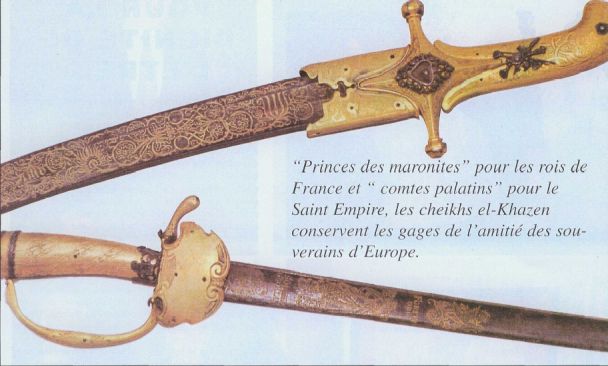

Population Movements to Keserwan - The Khazens and The Maans
ما جاء عن الثورة في المقاطعة الكسروانية
ثورة أهالي كسروان على المشايخ الخوازنة وأسبابها
Origins of the "Prince of Maronite" Title
Growing diversity: the Khazin sheiks and the clergy in the first decades of the 18th century
Historical Members:
Barbar Beik El Khazen [English]
Patriach Toubia Kaiss El Khazen(Biography & Life Part1 Part2) (Arabic)
Patriach Youssef Dargham El Khazen (Cont'd)
Cheikh Bishara Jafal El Khazen
Patriarch Youssef Raji El Khazen
The Martyrs Cheikh Philippe & Cheikh Farid El Khazen
Cheikh Nawfal El Khazen (Consul De France)
Cheikh Hossun El Khazen (Consul De France)
Cheikh Abou-Nawfal El Khazen (Consul De France)
Cheikh Francis Abee Nader & his son Yousef
Cheikh Abou-Kanso El Khazen (Consul De France)
Cheikh Abou Nader El Khazen
Cheikh Chafic El Khazen
Cheikh Keserwan El Khazen
Cheikh Serhal El Khazen [English]
Cheikh Rafiq El Khazen [English]
Cheikh Hanna El Khazen
Cheikha Arzi El Khazen
Marie El Khazen