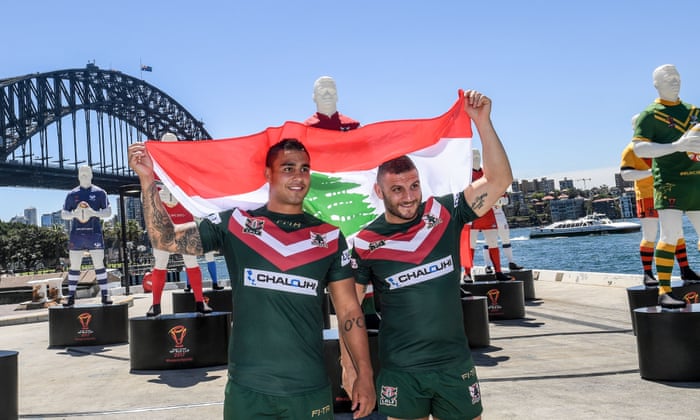
by Joe Gorman - The guardian - Every rugby league season for the past few years, Chris Saab has worked long hours at his earthmoving business during the day, trained three nights a week, and given up weekends to play in Sydney’s Ron Massey Cup. At 35 years of age, he is physically and mentally ready to retire. In fact he was ready to call it a day back in 2015, after helping the Lebanese national team qualify for their second Rugby League World Cup. But the lure of playing with his best friend, Robbie Farah, convinced him otherwise. “He’s getting on in his career,” explains Farah. “I know at times he’s thought about giving the game away, but in the back of his mind has been wanting to be a part of this World Cup. It’s going to be one of the highlights of my career to play alongside him. I made my debut for Lebanon as an 18-year-old, as did he, and we’ve been best mates ever since. Our careers since then have gone down different paths, and we haven’t been able to play alongside each other since that first game.” While Farah went on to win a NRL premiership and play State of Origin for New South Wales, Saab lived out a journeyman career in Sydney’s lower grades. He gave up on his dream of playing in the NRL years ago. He only continued playing at all, he said, “because I want to play for Lebanon and I wanted to qualify for the World Cup”. Rugby league’s flexible eligibility rules have been a major talking point of the 2017 World Cup. The rules allow players such as Farah, who has previously represented Australia, to switch to a tier two nation such as Lebanon. Already Andrew Fifita has controversially defected to Tonga after being selected for the Kangaroos.
Opinion is divided between those who believe these rules turn the tournament into a gimmick, and those who believe they are essential to grow the game internationally. Many of the nations that have qualified for this year’s tournament are filled with Australians. When the Kangaroos play Lebanon in Sydney, for example, it will almost be like Australia “A” versus Australia “B” as NRL stars such as Farah, Mitchell Moses and Tim Mannah line up for the Cedars. “There’s a fair bit of pride in those players for their upbringing and their parents, and some of the hardships that their families went through in the early years when they migrated to this country,” said Tas Baitieri, a development officer for the Rugby League International Federation. “A lot do it out of respect. And you know, having a bit of respect isn’t a bad thing for young people today.”
The story of Saab is just one example. His father, Joe, migrated to Australia with just a couple of dollars in his pocket and a suitcase full of clothes. He never wanted his son to play rugby league. “I started playing footy when I was seven,” explains Saab. “I think it was an Under-10s or Under-12s game, my father came to watch and I got a massive cork in my leg. I was on the floor crying, and my dad jumped the fence. He was a massive guy – six foot seven – and he actually put me on his shoulder, pushed the trainer out of the way and carried me off the field. Since then he wasn’t real keen on the footy thing. Still, when Saab debuted for Lebanon in a Test match against France in 2002, his father travelled to Tripoli to watch him play. The Cedars won 36-6 and Joe was converted. “That was the first time he’d been back to see his sister and his family in 33 years,” says Saab.
BEIRUT (Xinhua) — Lebanese citizen Assaad Bazzi and his family were standing on the barbed wired fence along the Lebanese-Israeli border at …
Four people were arrested for allegedly trying to sell on the picture, known as Portrait of Mrs Reeves. Police confiscated it last …
BEIRUT, Oct. 17 (Xinhua) — The Lebanese Parliament kicked off Tuesday a 3 day session to discuss the 2017 state budget, the …




Population Movements to Keserwan - The Khazens and The Maans
ما جاء عن الثورة في المقاطعة الكسروانية
ثورة أهالي كسروان على المشايخ الخوازنة وأسبابها
Origins of the "Prince of Maronite" Title
Growing diversity: the Khazin sheiks and the clergy in the first decades of the 18th century
Historical Members:
Barbar Beik El Khazen [English]
Patriach Toubia Kaiss El Khazen(Biography & Life Part1 Part2) (Arabic)
Patriach Youssef Dargham El Khazen (Cont'd)
Cheikh Bishara Jafal El Khazen
Patriarch Youssef Raji El Khazen
The Martyrs Cheikh Philippe & Cheikh Farid El Khazen
Cheikh Nawfal El Khazen (Consul De France)
Cheikh Hossun El Khazen (Consul De France)
Cheikh Abou-Nawfal El Khazen (Consul De France)
Cheikh Francis Abee Nader & his son Yousef
Cheikh Abou-Kanso El Khazen (Consul De France)
Cheikh Abou Nader El Khazen
Cheikh Chafic El Khazen
Cheikh Keserwan El Khazen
Cheikh Serhal El Khazen [English]
Cheikh Rafiq El Khazen [English]
Cheikh Hanna El Khazen
Cheikha Arzi El Khazen
Marie El Khazen