by Rania Ghanem The 2016 average room rate in Beirut hotels was the same level as that in 1996, which was $166. …
by Naharnet U.S. President Donald Trump compared Hizbullah in a landmark speech on Sunday to extremist organizations such as Islamic State and …
by Wendell Steavenson- The guardian
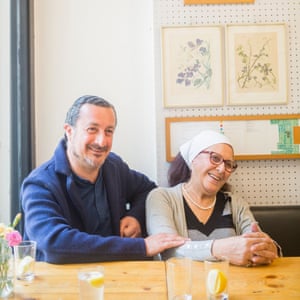
Kamal Mouzawak grew up in Jeita, a small town in the mountains north of Beirut, during the Lebanese civil war. One of his earliest memories was when his mother was out of the kitchen and he decided to make a cake. He thought to himself: ‘What is a cake?’ He stirred a slurry of flour, sugar and eggs in an empty sardine tin because he could not find a cake pan and cooked it on top of the stove. “It was a burnt omelette!” he laughed, remembering the experiment over lunch this spring in Beirut. “But what still amazes me is the metamorphosis of ingredients.” Over the last decade, Mouzawak has created a recipe for transforming people’s lives through food. He now presides over a network of markets, restaurants, bed-and-breakfasts and community outreach programmes in Lebanon.
Some projects are non-profit, others for-profit, and through them Mouzawak has developed a model of social entrepreneurship that is as much about empowering people as selling products. His brings together farmers, chefs, NGOs, designers and artisans, connecting people to politicians and business to ethics. One morning, in his main restaurant in Beirut, I watched him conduct three business meetings simultaneously, moving from table to table, discussing photographs for a new cookbook, plans for a new restaurant and giving a quick briefing to a group of European journalists on a tour. His enterprise is called Souk el Tayeb. Souk is Arabic for market and tayeb is a useful word with several meanings, including good, kind, delicious. It signifies acceptance, acknowledgement and thank you all rolled into one. Souk el Tayeb began as a farmers’ market in 2004.
I lived in Beirut when the market first opened on a scratched patch of car park, one of the bald spots in a city destroyed by 15 years of civil war. It sold orange blossom honey from the citrus orchards in the south, thick dark pomegranate molasses made by a grandmother in a mountain village, jars of pickled radishes, cucumbers, peppers; feta cheese preserved in oil with thyme and chillies. The sambousek stuffed with ground lamb and spinach always sold out within the first hour. Fresh fruit from across Lebanon at the Souk el Tayeb farmers’ market in Beirut. Facebook Twitter Pinterest Fresh fruit from across Lebanon at the Souk el Tayeb farmers’ market in Beirut. Photograph: Natalie Naccache for the Observer The market is still one of the great wonders of the Middle East. I walked along the rows of stalls one recent sunny spring Saturday morning, marvelling, wide-eyed and hungry.
By Jordyn Phelps & RYAN STRUYK ABC news
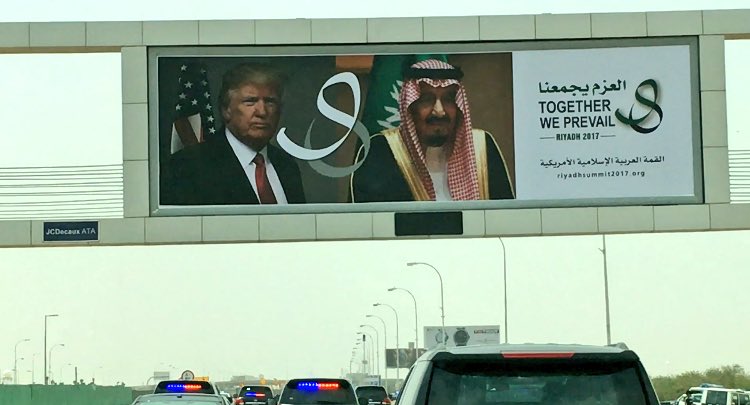
President Trump signed a $110 billion arms deal with Saudi Arabia on Saturday, the initial day of his first foreign trip since taking office. "That was a tremendous day. Tremendous investments in the United States," Trump said. "Hundreds of billions of dollars of investments into the United States and jobs, jobs, jobs," he said. The agreement commits Saudi Arabia to buying military equipment from the U.S. and to hiring American companies to build such equipment in Saudi Arabia, according to Gary Cohn, the president's chief economic adviser. The deal includes tanks and helicopters for border security, ships for coastal security, intelligence-gathering aircraft, a missile-defense radar system and cybersecurity tools, according to the State Department.
In a joint press appearance on Saturday with the Saudi foreign minister, Secretary of State Rex Tillerson praised the pact as a "historic moment in U.S.-Saudi relations." He also expressed an openness to talks with Iran. “I’ve never shut off the phone to anyone that wants to talk or have a productive conversation,” he said. “At this point, I have no plans to call my counterpart in Iran, although in all likelihood we will talk at the right time.”. Tillerson said the pact sends a "very strong message to our common enemies" on trying to disrupt "violent extremist messaging" and "financing of terrorism." He also said the deal "lowers the cost to the American people of providing security in this region."
The Trump administration has been working to finalize the deal over the past several months. White House press secretary Sean Spicer called the deal "huge news for U.S. companies and American workers who will benefit" in a tweet on Saturday morning. This is huge news for US companies and American workers who will benefit #jobs https://t.co/9RarqOwVAy — Sean Spicer (@PressSec) May 20, 2017
Trump's son-in-law and adviser Jared Kushner personally called the president of Lockheed Martin, a major supplier of U.S. military equipment, in order to negotiate a lower price for the radar system, according to the New York Times. "This package of defense equipment and services supports the long-term security of Saudi Arabia and the Gulf region in the face of malign Iranian influence and Iranian related threats. Additionally, it bolsters the Kingdom's ability to provide for its own security and continue contributing to counterterrorism operations across the region, reducing the burden on U.S. military forces," the State Department said in a statement. A White House official added that in addition to demonstrating the U.S. commitment to Saudi Arabia "and our Gulf partners," it also expands "opportunities for American companies in the region, and supporting tens of thousands of new jobs in the U.S. defense industrial base."
Population Movements to Keserwan - The Khazens and The Maans
ما جاء عن الثورة في المقاطعة الكسروانية
ثورة أهالي كسروان على المشايخ الخوازنة وأسبابها
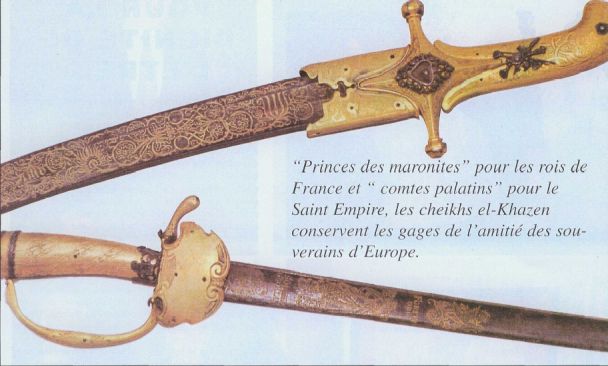
Origins of the "Prince of Maronite" Title
Growing diversity: the Khazin sheiks and the clergy in the first decades of the 18th century
Historical Members:
Barbar Beik El Khazen [English]
Patriach Toubia Kaiss El Khazen(Biography & Life Part1 Part2) (Arabic)
Patriach Youssef Dargham El Khazen (Cont'd)
Cheikh Bishara Jafal El Khazen
Patriarch Youssef Raji El Khazen
The Martyrs Cheikh Philippe & Cheikh Farid El Khazen
Cheikh Nawfal El Khazen (Consul De France)
Cheikh Hossun El Khazen (Consul De France)
Cheikh Abou-Nawfal El Khazen (Consul De France)
Cheikh Francis Abee Nader & his son Yousef
Cheikh Abou-Kanso El Khazen (Consul De France)
Cheikh Abou Nader El Khazen
Cheikh Chafic El Khazen
Cheikh Keserwan El Khazen
Cheikh Serhal El Khazen [English]
Cheikh Rafiq El Khazen [English]
Cheikh Hanna El Khazen
Cheikha Arzi El Khazen
Marie El Khazen