by Joseph A. Kechichian, Senior Writer - article represents opinion of the author
Beirut: Prime Minister Sa‘ad Hariri vented his frustration over failures of Lebanese politicians to reach consensus over a new electoral law. He affirmed that he would consider his government a “failure” if one isn’t reached. Politicians have been debating revising the archaic 1960 voting law since 2005 and have yet to reach consensus. According to the 1960 voting law, parliament seats are allocated by religious sects which Lebanon’s most prominent Christian parties want to amend. They say the law marginalises Christian voters, because, in the winner-take-all model Muslim voters in predominantly Christian districts cast their ballots to candidates backed by lists dominated by non-Christian parties.

by Kevan Gibbs
In delivering the eulogy at last Monday’s funeral of ANSA McAL founder and chairman emeritus Anthony Sabga, his son Norman Sabga noted that his father’s “greatest source of pride was his family”. And in last week’s Sunday Guardian, former journalist and culture researcher Kim Johnson in an interview noted that Sabga “lived for his family...he told me he thought a lot of Trinidad’s problems, social and otherwise, crime and so on, would not have occurred if people had been more committed to their families.”
The centrality of family is just one of a suite of values which explain the success of Lebanese emigrants and their descendants in different parts of the world. The marriage rate in the Syrian-Lebanese community in Trinidad and Tobago is 66 per cent, compared to a national average of 51 percent and, unusually among wealthy people, over 1 in ten Syrian-Lebanese couples have four or more children. (See Table.)
In their book The Triple Package, authors Amy Chua & Jed Rubenfield write: “The famously entrepreneurial Lebanese have one of the most successful diasporas in the world...Although tiny in numbers, Lebanese minorities are disproportionately successful throughout Latin America, West Africa, and the Caribbean.” In 2010, Mexican telecom tycoon Carlos Slim was ranked the richest man in the world, with a net worth of over US$70 billion. Slim is of Lebanese descent. In T&T, the man in the street seems to think that some “Syrians” may have profited from illegal activities—however, even if this were true of individuals, it does not explain the success of the group nor why Lebanese have been similarly successful in all parts of the world in virtually the same types of business.
In America, the first wave of Lebanese immigrants arrived between 1881 and 1925. They were mainly Christian and, as in Trinidad, were mostly peddlers, selling clothes and other items door to door, walking or riding their bicycles for miles. A century later, the median household income of Lebanese-Americans is almost one-third higher than the national American average (US$67,000 compared to US$51,000). Similar data for T&T are not available, but the 2005 Survey of Living Conditions notes that, for Syrian-Lebanese “virtually everybody was among the non-poor” with 83 per cent occupying the top fifth economic stratum and the rest in the fourth highest.

Ara Tekian, professor and associate dean of international education at the College of Medicine, is among recipients of the Ellis Island Medal of Honor. The award is given to those who “have made it their mission to share with those less fortunate their knowledge, courage and compassion, while maintaining the traditions of their ethnic heritage as they uphold the ideals and spirit of America,” according to the National Ethnic Coalition of Organizations, the group that gives the award. Past recipients include six U.S. presidents, former Secretary of State Hillary Clinton, Frank Sinatra, Elie Wiesel and Rosa Parks.
The 2017 awardees, who were honored May 13 in New York City, include astronaut Buzz Aldrin, cardiologist Annapoorna Kini and CNN anchor Fareed Zakaria. Tekian was born in Beirut, Lebanon. He received his doctorate in neuroscience from the American University in Beirut in 1981 and earned a master’s in health professions education at UIC in 1983. “This was a very unique degree at the time, and UIC was one of the only universities in the world to offer it,” Tekian said.
He returned to the Middle East that year and became the founding director of the medical education department at King Saud University College of Medicine in Riyadh, Saudi Arabia. He later consulted for the World Health Organization and the Ministries of Health and Education to ensure that medical schools in the Middle East were adequately preparing their students to provide care in their respective countries.
In 1990, with the civil war still ongoing in his native Lebanon, Tekian left the Middle East and moved to the U.S. Tekian joined UIC in 1992 as a visiting assistant professor of medical education and was instrumental in building UIC’s international programs. Since then, he has consulted in more than 45 countries and helped establish more than a dozen medical education departments or centers. “When I moved to the U.S., I knew that I wanted to do everything I could to help the Lebanese and Armenian communities that I joined here in America,” he said. “When you have a shared history with people, and when you are an immigrant yourself, you have a very strong desire to help your people.”
For Tekian, that desire took the form of assisting Armenian and Lebanese students seeking to further their medical education in this country. To them and their families, he became known as “the Contact Person.” His extensive contacts at universities in the U.S., the Middle East and Europe helped him direct students to educational opportunities in graduate and post-graduate work. He established the UIC College of Medicine’s International Medical Education Program in 2009. “Dr. Tekian put UIC on the map in terms of medical education,” said Robert Barish, vice chancellor for health affairs. “He is one of the main reasons why we are known as innovators in medical education around the world.”

Beirut – The Lebanese government will extend Central Bank Governor Riad Salameh’s term, which was due to expire this summer, a governmental source told Asharq Al-Awsat. The source said that during a cabinet session on Tuesday, Lebanese ministers would renew, for the sixth time, the governor’s term until 2023, in a measure aimed at reassuring the Lebanese banking sector, which regards Salameh as the guarantor of Lebanon’s monetary position. A well-informed Lebanese source said that Finance Minister Ali Hassan Khalil has sent a letter to the Cabinet, asking for the extension of the term of the governor of “Banque du Liban” by six years. Salameh was first assigned to this post in 1993 under the government of late Prime Minister Rafik al-Hariri.
The sources also noted that the finance minister referred the extension request to the cabinet, after overcoming previous objections by President Michel Aoun, who was calling for the appointment a new governor. A senior banker, speaking on condition of anonymity, told Asharq Al-Awsat that, based on the need to preserve the safety of Lebanon’s monetary sector and to “prevent adventures into the unknown”, an agreement was reached to renew Salameh’s tenure. Meanwhile, in an interview with Reuters published in February, the Central Bank governor said that Lebanon has met all the conditions set by FATF-GAFI (Financial Action Task Force) for fighting money laundering and was no longer subject to country follow-up. FATF reported at a plenary meeting held in Paris in February that Lebanon has, legally and in practice, met all the required conditions to combat money laundering and terrorist financing.
According to Salameh, the FATF statement, issued by its 199 member states, is a reassuring factor for Lebanon’s international banking and financial dealings, and for Lebanese banks’ customers, particularly the Lebanese diaspora, as it facilitates their incoming and outgoing transfers to and from Lebanon. Speaking to Reuters on the sidelines of a Euromoney conference in Beirut on Monday, the Central Bank governor said: “Today we have a situation that is stable, which doesn’t warrant any special operations.” “Depending on what would be necessary, we have various strategies we can implement; it is not essential that we go back to the same strategy we used in 2016,” he added, as quoted by Reuters.
Population Movements to Keserwan - The Khazens and The Maans
ما جاء عن الثورة في المقاطعة الكسروانية
ثورة أهالي كسروان على المشايخ الخوازنة وأسبابها
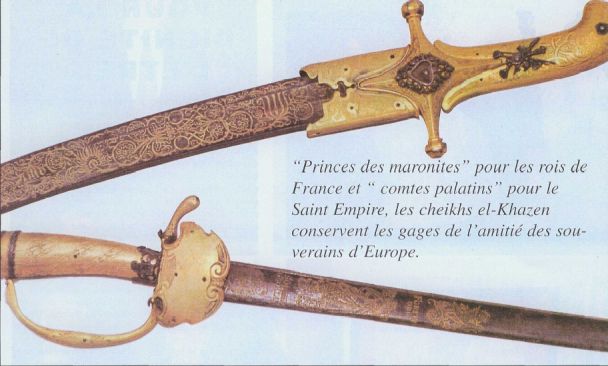
Origins of the "Prince of Maronite" Title
Growing diversity: the Khazin sheiks and the clergy in the first decades of the 18th century
Historical Members:
Barbar Beik El Khazen [English]
Patriach Toubia Kaiss El Khazen(Biography & Life Part1 Part2) (Arabic)
Patriach Youssef Dargham El Khazen (Cont'd)
Cheikh Bishara Jafal El Khazen
Patriarch Youssef Raji El Khazen
The Martyrs Cheikh Philippe & Cheikh Farid El Khazen
Cheikh Nawfal El Khazen (Consul De France)
Cheikh Hossun El Khazen (Consul De France)
Cheikh Abou-Nawfal El Khazen (Consul De France)
Cheikh Francis Abee Nader & his son Yousef
Cheikh Abou-Kanso El Khazen (Consul De France)
Cheikh Abou Nader El Khazen
Cheikh Chafic El Khazen
Cheikh Keserwan El Khazen
Cheikh Serhal El Khazen [English]
Cheikh Rafiq El Khazen [English]
Cheikh Hanna El Khazen
Cheikha Arzi El Khazen
Marie El Khazen