By Reem Hosam El-din -albawaba.com – A forecast report conducted by Colliers International for the hotels of the Middle East and North …

She doesn’t like me to use my laptop while she’s speaking, let alone record, so I fidget notes onto a pad with one hand. She winces when she sees me doing this. “My life; my story — it’s nothing; look at what’s happening today.” Language gets in the way. Spanish is her mother tongue. Next came French. Then Italian, then Arabic. Her fifth language was English, acquired in her 40s, so a bit imprecise. Her story spans countries, conflicts, wars, and decades. The chronology isn’t the most important thing. Nor is the geography. The facts are blurred to begin with.
What’s important is what remains. What triumphed. Her name is Encarnation Bayon.Mother of two, grandmother to three.
Her life includes the most astonishing events: the Spanish Civil War and life in an orphanage; bigamy — hers; forbidden cross-cultural love; assassination of her prominent Jewish husband in Lebanon; fleeing, penniless with her children to Vancouver to start life over again.
Encarna’s daughter, Marie Khouri, is a Canadian artist of considerable renown. She has just returned from an installation at the Crillon Hotel in Paris. Her work is largely informed by her mother’s remarkable story and intergenerational trauma.
This story is about how, when we look at our mothers, all we see is the apron, when many of their lives conceal epics like Encarna’s.
Survivor of some of the 20th century’s most catastrophic upheavals, she is a woman with a singular gift for living.
“My mother had a big garden. I remember everyone outside, crying. We must have just had the news about my father,” says Encarna, whose father was one of the Republican dead, killed by Franco’s men in the waning days of the Spanish Civil War. He left behind a wife and nine children. “This is the way, the last moment, I remember of my family; crying.” Encarna is a compact woman with a taste for simplicity. She favours well-cut black clothing and bold pieces of jewellery. Her complexion is the colour of toast but the texture of velvet.
When I look up, she turns her face to me, a puzzled smile tracing across it. It’s as if she’s tossed me a ball, so lightly, so casually. I’ve caught the ball but the ball has turned out to be surprisingly heavy. I see now that she understands I don’t know how to play this game; that few people know how to play this game with her: The game of unexpected gravity. She is an expert at living; I’m an amateur.
Riad Salameh, Governor of the Banque Du Liban and HE Essa Kazim, Governor of DIFC by cpifinancial.net – The audience was addressed …

By Youssef Diab - english.aawsat.com
Beirut – Lebanese detainees arrested on terrorism charges in Lebanese prisons launched their “empty stomachs” campaign and began their open hunger strike until their demands are met and a general amnesty is issued leading to their release. Sheikh Khaled Hoblos, detained in Roumieh Prison, declared a mass hunger strike at Lebanese prisons on Saturday with the participation of 850 prisoners of several prisons. The announcement for the strike came through an audio clip of Hoblos released from prison where he announced “a hunger strike to demand a general amnesty” urging the prison administrations not to force inmates to end their hunger strike, deeming it “a right guaranteed by the law.”
He asked politicians to grant prisoners an amnesty aside from any political motives, he also called on Prime Minister Saad Hariri to prioritize Lebanon’s national interest. Meanwhile, a Lebanese security source confirmed that hundreds of detainees had indeed begun their strike and refused to receive their daily meals. The source told Asharq Al-Awsat newspaper that the number of prisoners participating in the strike reached 575 out of 600, 200 from Tripoli prison in the north, and about 60 others from Jezzine prison, south Lebanon. He added that prison administration began monitoring the prisoners and is following up on their medical situation. Prior to the strike, families of inmates blocked the roads and began protests to press for general amnesty at the beginning of the presidency of President Michel Aoun.
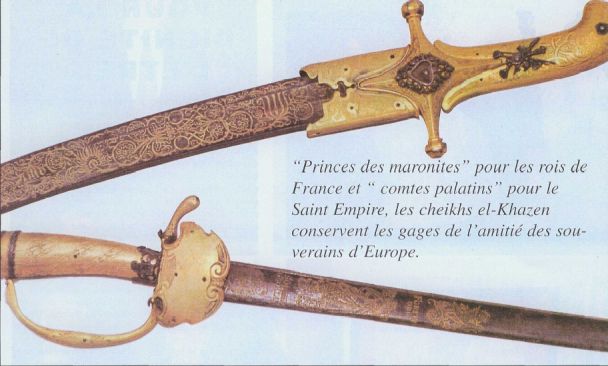
Population Movements to Keserwan - The Khazens and The Maans
ما جاء عن الثورة في المقاطعة الكسروانية
ثورة أهالي كسروان على المشايخ الخوازنة وأسبابها
Origins of the "Prince of Maronite" Title
Growing diversity: the Khazin sheiks and the clergy in the first decades of the 18th century
Historical Members:
Barbar Beik El Khazen [English]
Patriach Toubia Kaiss El Khazen(Biography & Life Part1 Part2) (Arabic)
Patriach Youssef Dargham El Khazen (Cont'd)
Cheikh Bishara Jafal El Khazen
Patriarch Youssef Raji El Khazen
The Martyrs Cheikh Philippe & Cheikh Farid El Khazen
Cheikh Nawfal El Khazen (Consul De France)
Cheikh Hossun El Khazen (Consul De France)
Cheikh Abou-Nawfal El Khazen (Consul De France)
Cheikh Francis Abee Nader & his son Yousef
Cheikh Abou-Kanso El Khazen (Consul De France)
Cheikh Abou Nader El Khazen
Cheikh Chafic El Khazen
Cheikh Keserwan El Khazen
Cheikh Serhal El Khazen [English]
Cheikh Rafiq El Khazen [English]
Cheikh Hanna El Khazen
Cheikha Arzi El Khazen
Marie El Khazen